
Chia pudding sounds effortless until the first batch turns watery, clumpy or unpleasantly thick. The fix is not a special “detox” ingredient—it is the right seed-to-liquid ratio, two thorough stirs and enough chilling time. This chia seed pudding recipe gives you a dependable base, practical substitutions, topping combinations and clear guidance on what this breakfast can—and cannot—do for health.
Quick answer: Stir 2 tablespoons of chia seeds into 1/2 cup of milk, add vanilla and optional sweetener, wait 5 minutes, stir again, then refrigerate for at least 2 hours. Add yogurt for a creamier, more substantial pudding and finish with fruit, nuts or seeds.
Editorial note: This is an editorial recipe, not personalized medical advice. It has not been medically reviewed or laboratory analyzed. Nutrition varies with the milk, yogurt, sweetener and toppings you choose. NutriQuora does not claim that chia pudding treats PCOS, causes weight loss or controls blood sugar. Read our editorial and corrections policy.
Table of contents
- The reliable chia pudding ratio
- Ingredients and substitutions
- How to make chia seed pudding
- Why the recipe thickens
- Nutrition context without the hype
- Chia pudding and PCOS
- Lower-added-sugar options
- Topping combinations
- Troubleshooting
- Storage and food safety
- Frequently asked questions
Chia seed pudding recipe at a glance
| Recipe detail | Amount or time |
|---|---|
| Chia seeds | 2 tablespoons |
| Milk | 1/2 cup |
| Optional Greek yogurt | 1/4 cup |
| Prep time | 5–10 minutes |
| Initial rest | 5 minutes before the second stir |
| Chilling time | At least 2 hours; overnight is convenient |
| Yield | 1 generous breakfast or 2 smaller snacks |
| Dietary pattern | Vegetarian; vegan if you use plant milk and skip dairy yogurt |
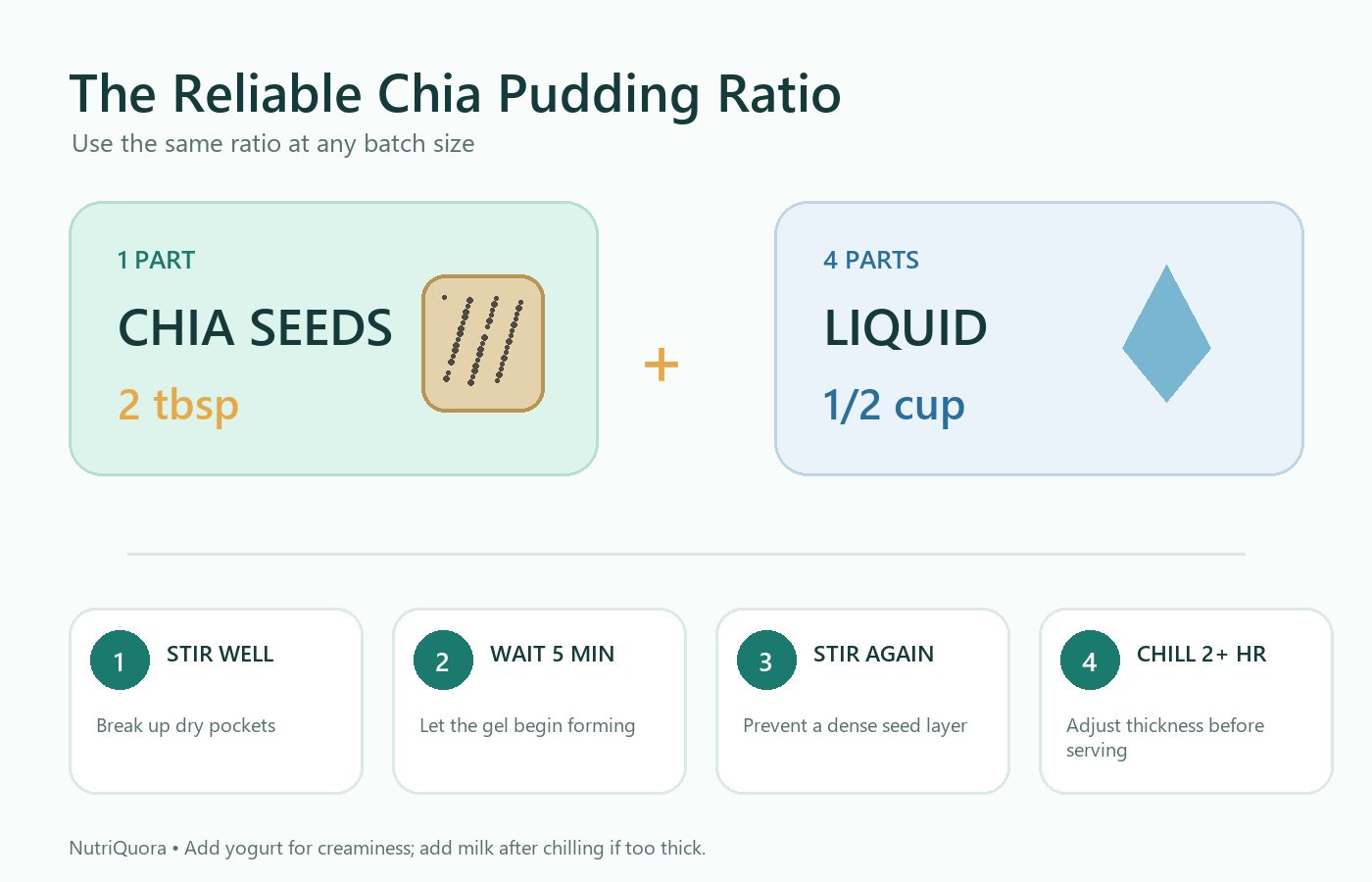
The base ratio is 1 part chia seeds to 4 parts liquid by volume. It is easy to scale: use 1/4 cup chia seeds with 1 cup milk for two generous portions.
Chia seed pudding recipe ingredients and substitutions
For the pudding
- 2 tablespoons chia seeds
- 1/2 cup dairy milk or unsweetened plant milk
- 1/4 cup plain Greek yogurt, optional
- 1/2 teaspoon vanilla extract
- 1/4 teaspoon ground cinnamon, optional
- 1/2 to 1 teaspoon maple syrup or honey, optional
- A small pinch of salt
For serving
Choose one or two rather than adding every topping at once:
- 1/4 cup berries or chopped fruit
- 1 tablespoon chopped almonds, walnuts or pumpkin seeds
- 1 teaspoon ground flaxseed or hemp hearts
- 1 teaspoon cacao nibs or unsweetened coconut
Substitution guide
| If you need… | Try… | What changes |
|---|---|---|
| A vegan version | Soy, almond or oat milk; skip Greek yogurt | Soy milk generally adds more protein than almond milk |
| A nut-free version | Dairy milk, soy milk or oat milk; use pumpkin or sunflower seeds | Check packaged products for allergen statements |
| A creamier texture | Add plain Greek yogurt | The pudding becomes thicker and tangier |
| A thinner texture | Add 1–2 tablespoons milk after chilling | Stir before adding more liquid |
| Less added sugar | Skip syrup and use ripe berries or cinnamon | Fruit still contributes naturally occurring sugar |
| More sweetness | Add sweetener 1/2 teaspoon at a time | Taste after chilling; cold foods can seem less sweet |
How to make this chia seed pudding recipe
1. Combine the base
Add the milk, vanilla, cinnamon, optional sweetener and salt to a jar or bowl. Stir in the chia seeds until no dry pockets remain. If using Greek yogurt, whisk it with the milk before adding the seeds so it disperses evenly.
2. Wait five minutes
Leave the mixture at room temperature for about 5 minutes. The seeds begin absorbing liquid quickly, and some will settle or form small clumps.
3. Stir a second time
Stir firmly, scraping the bottom and corners of the container. This second stir is the most useful step for preventing a dense layer of seeds at the bottom.
4. Cover and chill
Cover the container and refrigerate for at least 2 hours. Overnight chilling is convenient for breakfast meal prep.
5. Adjust and serve
Stir the pudding. If it is thicker than you like, add milk 1 tablespoon at a time. If it is thin, stir in 1 teaspoon chia seeds, wait 20–30 minutes and check again. Add toppings immediately before eating for better texture.
Why this chia seed pudding recipe thickens
Chia seeds form a gel when exposed to liquid. Harvard’s Nutrition Source notes that chia seeds can absorb water quickly—up to about 10 times their weight—and identifies mucilage as the material responsible for their gel-like texture.[2] The second stir distributes the seeds before the gel fully forms, which reduces clumps and gives the pudding a more even consistency.
Harvard also provides a similar preparation reference: 1/4 cup chia seeds with 1 cup liquid, chilled until thick.[2] This recipe uses the same proportion in a single-serving format.
Chia seed pudding recipe nutrition without “superfood” hype
Chia seeds are nutrient-dense, but they are not a cure or a shortcut. According to Harvard’s Nutrition Source, 2 tablespoons (about 28 grams) provide approximately 140 calories, 4 grams of protein, 11 grams of fiber and 7 grams of unsaturated fat, along with calcium and trace minerals.[2]
Those figures describe the chia seeds—not the completed pudding. Your total depends on the milk, yogurt, sweetener and toppings. For example:
- Plain Greek yogurt can add protein and creaminess.
- Unsweetened plant milk may reduce added sugar, but protein varies widely by product.
- Nuts and seeds add energy as well as texture and unsaturated fat.
- Sweetened milk, flavored yogurt and large amounts of syrup can substantially increase added sugar.
What chia pudding can and cannot do
It can:
- Offer a convenient way to include fiber-rich seeds
- Be prepared ahead for breakfast or a snack
- Be adapted for vegan, nut-free or lower-added-sugar preferences
- Contribute to a balanced eating pattern when paired with foods you tolerate
It cannot:
- Treat or cure PCOS
- Guarantee weight loss
- Replace diabetes treatment or prescribed medication
- “Detox” the body
- Produce a specific blood-sugar response for every person
Human trials have not shown a specific standalone benefit of chia seeds for body weight, blood pressure, blood lipids, blood sugar or inflammation.[2] That does not make chia seeds unhealthy; it means the evidence supports treating them as food, not medicine.
Can this chia seed pudding recipe fit a PCOS eating pattern?
Yes, it can fit—but there is no single required “PCOS diet.” The 2023 International Evidence-based PCOS Guideline states that evidence does not support one diet composition over another for anthropometric, metabolic, hormonal, reproductive or psychological outcomes.[3] It recommends sustainable healthy eating that follows general population guidance and is tailored to a person’s preferences and goals.[3]
For some people, a breakfast that includes chia, plain yogurt, fruit and nuts is convenient and satisfying. Others may prefer eggs, oats or another breakfast entirely. If you use insulin or glucose-lowering medicine, have food allergies, experience digestive symptoms, are pregnant, or have been given a medical nutrition plan, ask your clinician or registered dietitian how this recipe fits your needs.
For more ideas—not a prescriptive PCOS diet—see these PCOS breakfast ideas.
Lower-added-sugar chia seed pudding recipe
A “low-sugar” label can be misleading because recipes differ. A practical approach is to reduce added sugar while keeping the recipe enjoyable:
- Choose unsweetened milk.
- Use plain rather than flavored yogurt.
- Start without syrup, then taste after chilling.
- Add berries, cinnamon or vanilla for flavor.
- Check packaged milk and yogurt labels for added sugars.
Simple no-added-sugar variation
Mix 2 tablespoons chia seeds, 1/2 cup unsweetened milk, 1/4 cup plain yogurt, vanilla and cinnamon. Chill, then add berries. This version contains naturally occurring sugars from milk or fruit but no syrup or honey.
Five balanced topping combinations
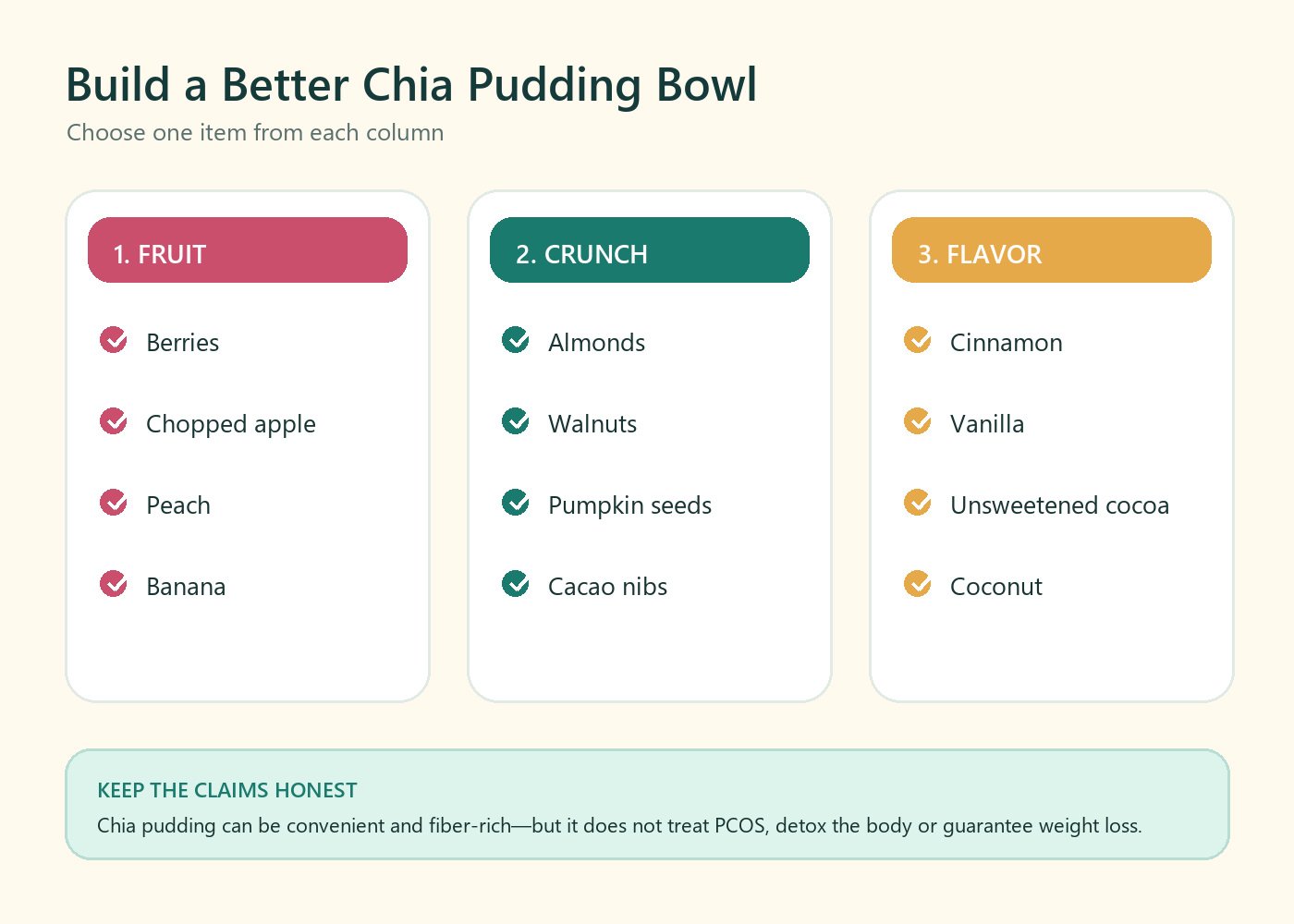
1. Berry-almond
Blueberries, sliced strawberries and chopped almonds.
2. Apple-cinnamon
Finely chopped apple, cinnamon and walnuts. Add the apple just before serving for crunch.
3. Cocoa-raspberry
Unsweetened cocoa stirred into the base, then raspberries and cacao nibs on top.
4. Peach-pumpkin seed
Chopped peach, pumpkin seeds and a pinch of cinnamon.
5. Banana-peanut
Sliced banana and 1 teaspoon peanut butter. Use a seed butter for a nut-free version.
A useful serving framework is fruit + crunch + flavor. One fruit, one nut or seed, and one spice usually gives enough contrast without turning breakfast into a long ingredient list.
Chia seed pudding recipe troubleshooting
| Problem | Likely cause | Fix |
|---|---|---|
| Seeds clump together | The mixture was stirred only once | Stir immediately and again after 5 minutes |
| Pudding is watery | Too much liquid or not enough chilling time | Chill longer; then add 1 teaspoon chia if needed |
| Pudding is too thick | The seeds absorbed more liquid than expected | Add milk 1 tablespoon at a time |
| Texture feels gritty | Seeds are unevenly distributed or not fully hydrated | Stir well and chill longer |
| Flavor is bland | The base has little seasoning | Add vanilla, cinnamon, cocoa or a small pinch of salt |
| It is too sweet | Sweetened milk, yogurt and syrup were combined | Use unsweetened products and add sweetness gradually |
Different brands and varieties can absorb liquid at slightly different rates, so final adjustments are normal.
Chia seed pudding recipe storage and food safety
Keep chia pudding covered in the refrigerator. The FDA advises refrigerating perishable foods promptly and keeping the refrigerator at or below 40°F (4°C).[4]
For best quality, make only what you expect to eat within about 3 days, especially when the pudding contains dairy yogurt or cut fruit. Add crunchy toppings at serving time. Discard the pudding if it was left at room temperature for more than 2 hours, or sooner in very hot conditions, and discard it if its appearance or smell seems questionable.[4]
Do not swallow spoonfuls of dry chia seeds and then chase them with water. Chia expands quickly in liquid; hydrate the seeds in the pudding before eating.[2]
Frequently asked questions
How long should chia pudding sit?
At least 2 hours gives the seeds time to hydrate evenly. Overnight chilling is convenient but not required.
Can I make chia pudding without yogurt?
Yes. Use 2 tablespoons chia seeds with 1/2 cup milk. Yogurt is optional and mainly changes creaminess, tang and protein content.
Can I use regular dairy milk?
Yes. Dairy milk, soy milk, almond milk and oat milk can all work. Choose based on allergies, preference and the nutrition profile you want.
Can I blend chia pudding?
Yes. Blend after the seeds have hydrated if you prefer a smoother texture. You may need a small splash of milk after blending.
Is chia pudding good for weight loss?
No single recipe guarantees weight loss. Chia pudding can be one convenient meal or snack, but body-weight change depends on many factors. Controlled human trials have not shown a specific standalone weight-loss effect from chia seeds.[2]
Is chia pudding keto?
“Keto” depends on the full ingredient list and a person’s carbohydrate target. Chia is fiber-rich, but milk, yogurt, fruit and sweetener all contribute carbohydrates. Check labels and seek professional guidance if you follow a medically supervised ketogenic diet.
Can children eat chia pudding?
A fully hydrated pudding may be easier to eat than dry seeds, but portion size, texture, allergies and choking risk depend on the child’s age and development. Ask a pediatric clinician if you are unsure, and supervise young children while eating.
Can I double this chia seed pudding recipe?
Yes. Use 1/4 cup chia seeds and 1 cup milk, plus up to 1/2 cup yogurt if desired. Mix in a larger container so there is room to stir thoroughly.
Bottom line
A dependable chia seed pudding recipe needs only a 1:4 seed-to-liquid ratio, a second stir and enough chilling time. Use the base recipe as a framework, then choose milk, yogurt, sweetness and toppings that fit your taste, budget, allergies and health needs. Enjoy chia as a nutrient-dense food—not as a cure, detox or guaranteed weight-loss tool.
Sources
[2] Harvard T.H. Chan School of Public Health, Chia Seeds
[4] U.S. Food and Drug Administration, Are You Storing Food Safely?
3 Responses