
A low calorie high protein breakfast sounds simple until the meal leaves you hungry an hour later—or turns into a dry plate of egg whites with no fiber or flavor. The better approach is not to chase the smallest possible calorie number. It is to build a satisfying meal around a useful protein source, produce, and enough carbohydrate or fat to fit your morning.
This guide gives you 12 practical breakfasts, including egg-free, vegetarian, dairy-free and meal-prep options. Each idea lands at approximately 200–400 calories and 20–46 grams of protein using the listed portions. Those ranges are an editorial framework for this article, not a prescription for every reader.
Quick answer: Start with a protein anchor such as Greek yogurt, cottage cheese, eggs, tofu, edamame, poultry or fish. Add fruit or vegetables, then include a measured fiber-rich carbohydrate or unsaturated fat. “Lower calorie” should still mean nutritionally useful and satisfying—not the smallest meal you can tolerate.
Editorial note: This article provides general nutrition education and has not been medically reviewed. The meals are not individualized treatment plans. Calorie and protein estimates are calculated from generic USDA FoodData Central entries and common product labels; brands, recipes and portions vary. Anyone with kidney disease, diabetes medication, pregnancy, an eating-disorder history or unusually high energy needs should seek individualized guidance. Read our editorial and corrections policy.
Table of contents
- What “low calorie” and “high protein” mean
- The four-part breakfast formula
- 12 breakfast ideas and macros
- Egg-free options
- Vegetarian and dairy-free swaps
- High-protein breakfast meal prep
- Common mistakes
- Who should not restrict breakfast calories
- Frequently asked questions
What is a low calorie high protein breakfast?
There is no official definition of a low calorie high protein breakfast. Calorie and protein needs change with body size, age, health, pregnancy, activity, appetite and the rest of the day’s food.
For this article, each breakfast provides approximately:
- 200–400 calories
- At least 20 grams of protein
- A fruit, vegetable, legume or whole-grain component when practical
These numbers make the recipes comparable; they do not make 400 calories a universal breakfast ceiling. Your low calorie high protein breakfast can be larger when your appetite, activity or clinical needs call for more food.
Harvard’s Nutrition Source summarizes a minimum adult protein recommendation of 0.8 grams per kilogram of body weight per day and notes that individual needs vary with factors such as age, exercise and health conditions.[3] It also emphasizes the whole protein “package”—including the fats, fiber, sodium and other nutrients that arrive with the protein food.[3]
That is why this guide does not rank a breakfast by protein grams alone.
Is a high-protein breakfast required for weight loss?
No. Breakfast is not a weight-loss requirement, and eating breakfast does not automatically reduce food intake later.
A systematic review of randomized trials found that adding breakfast was not a reliable weight-loss strategy; the included studies were short and generally had important limitations, so the findings require caution.[6] Eat breakfast if it supports your hunger, schedule, training or medication routine. Do not force it because a headline says everyone must eat in the morning.
Protein may improve perceived fullness for some people, but the effect is not absolute. A review of higher-protein diets described a modest satiety effect in acute studies and did not find consistent evidence of reduced intake at the next meal.[7]
A low calorie high protein breakfast can be useful. It is not a metabolic shortcut or a guarantee that you will eat less all day.
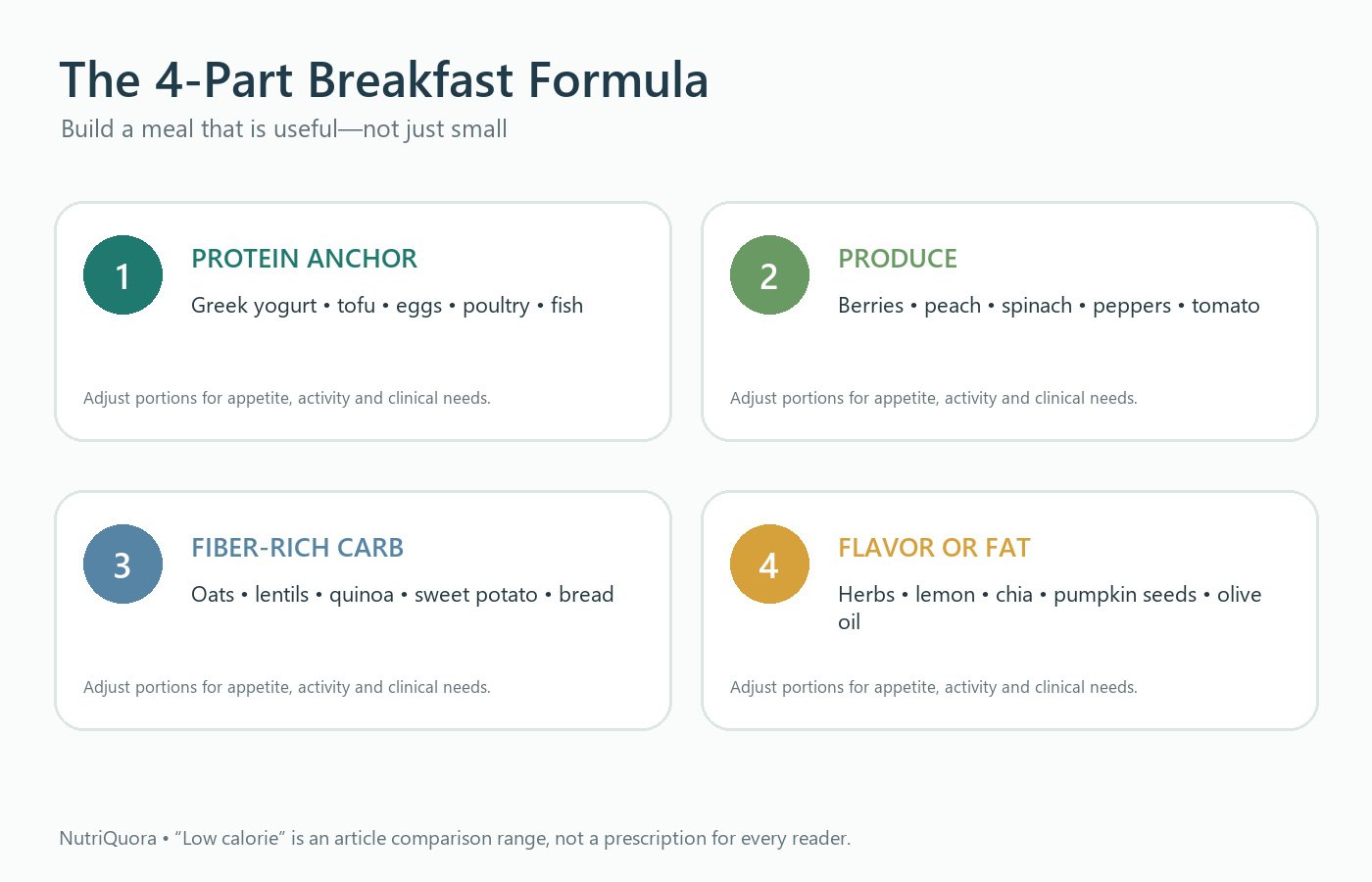
The four-part low calorie high protein breakfast formula
Use this flexible structure to build a low calorie high protein breakfast instead of relying on one recipe.
| Component | Purpose | Examples |
|---|---|---|
| Protein anchor | Supplies most of the meal’s protein | Greek yogurt, cottage cheese, eggs, tofu, edamame, chicken, turkey, fish |
| Produce | Adds volume, flavor and nutrients | Berries, peach, banana, spinach, peppers, tomato, cucumber |
| Fiber-rich carbohydrate | Adds texture and usable energy | Oats, lentils, quinoa, sweet potato, whole-grain bread, high-fiber wrap |
| Flavor or fat | Makes the meal enjoyable | Herbs, spices, lemon, pumpkin seeds, chia, small amount of olive oil |
The Dietary Guidelines for Americans, 2025–2030, emphasize whole, nutrient-dense foods across protein foods, dairy, vegetables, fruits, healthy fats and whole grains.[2] A breakfast does not need every group, but the overall pattern should be more varied than protein powder and water.
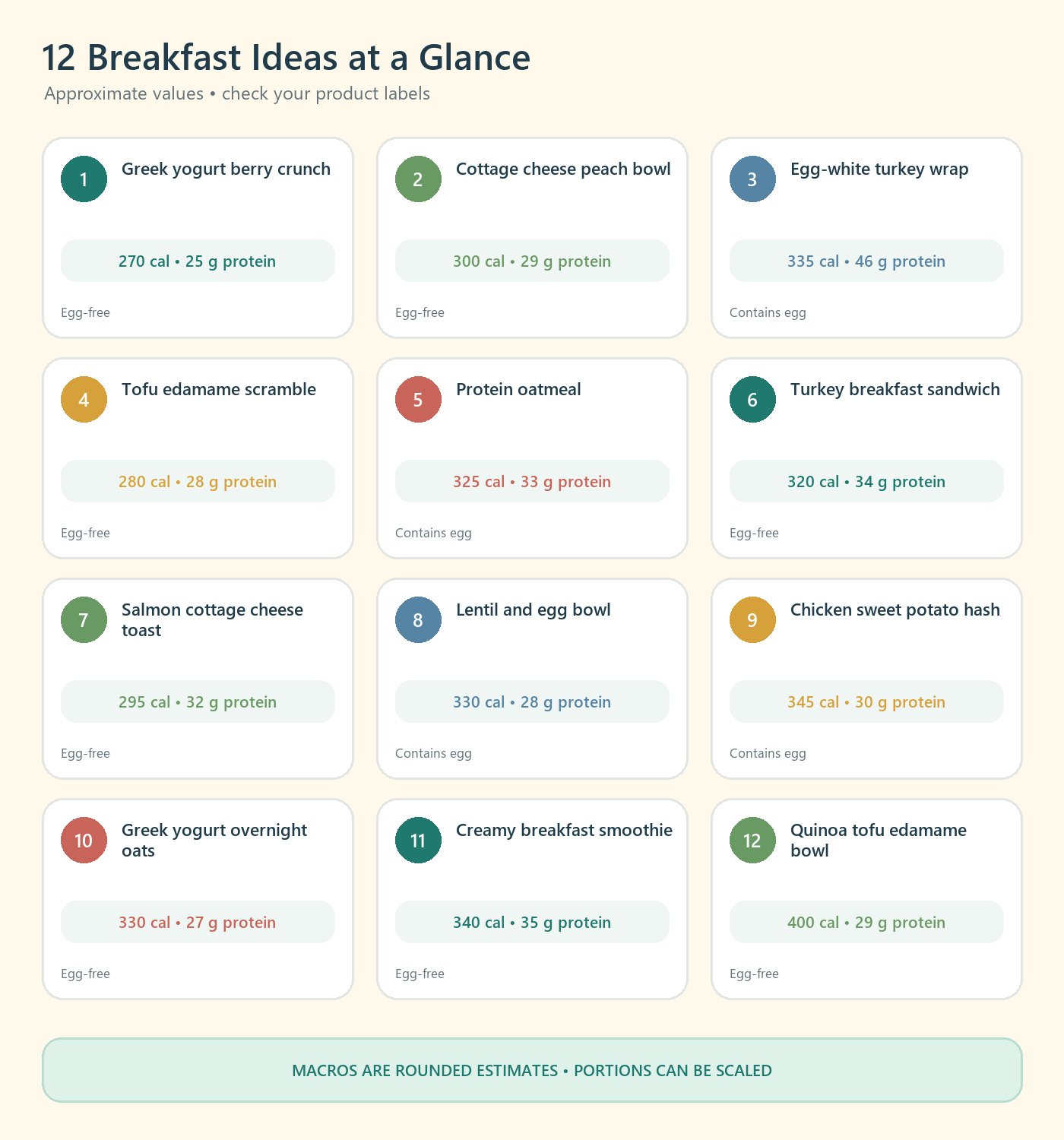
12 low calorie high protein breakfast ideas
At-a-glance low calorie high protein breakfast comparison
Use this low calorie high protein breakfast table to compare portions before choosing a recipe.
| Breakfast | Approx. calories | Approx. protein | Useful for |
|---|---|---|---|
| Greek yogurt berry crunch | 270 | 25 g | No cooking, vegetarian |
| Cottage cheese peach bowl | 300 | 29 g | No cooking, egg-free |
| Egg-white turkey wrap | 335 | 46 g | Very high protein, portable |
| Tofu edamame scramble | 280 | 28 g | Vegan, egg-free |
| Protein oatmeal with egg whites | 325 | 33 g | Warm breakfast, meal prep |
| Turkey breakfast sandwich | 320 | 34 g | Portable savory option |
| Salmon cottage cheese toast | 295 | 32 g | No cooking, pescatarian |
| Lentil and egg breakfast bowl | 330 | 28 g | Fiber-rich vegetarian option |
| Chicken sweet potato hash | 345 | 30 g | Leftover-friendly |
| Greek yogurt overnight oats | 330 | 27 g | Make-ahead vegetarian option |
| Creamy breakfast smoothie | 340 | 35 g | Drinkable, no powder required |
| Quinoa tofu edamame bowl | 400 | 29 g | Vegan and meal-prep friendly |
Macro-method note: Estimates use the listed weights, generic USDA FoodData Central values and typical label values for packaged items such as wraps.[9] They are rounded and are not laboratory analyses. Check your labels if a precise target matters.
1. Greek yogurt berry crunch
Ingredients
- 200 g plain nonfat Greek yogurt
- 100 g berries, about 2/3 cup
- 20 g rolled oats, about 2 tablespoons
- 5 g chia seeds, about 1 teaspoon
- Cinnamon or vanilla extract
Method: Add everything to a bowl and stir. Let it stand for five minutes if you prefer softer oats.
Estimated nutrition: 270 calories and 25 g protein.
This is an easy low calorie high protein breakfast when you want minimal preparation. Choose unsweetened yogurt and add sweetness with fruit when possible.
2. Cottage cheese peach bowl
Ingredients
- 225 g low-fat cottage cheese, about 1 cup
- 150 g sliced peach, about one medium peach
- 10 g pumpkin seeds, about 1 tablespoon
- Cinnamon
Method: Spoon cottage cheese into a bowl and add the peach, pumpkin seeds and cinnamon.
Estimated nutrition: 300 calories and 29 g protein.
Cottage-cheese sodium varies widely. Compare labels if you have been advised to limit sodium.
3. Egg-white turkey breakfast wrap
This portable low calorie high protein breakfast suits readers who prefer a savory meal.
Ingredients
- 200 g pasteurized liquid egg whites, about 3/4 cup
- 60 g roasted turkey breast, about 2 ounces
- 100 g peppers, mushrooms or spinach
- 1 high-fiber wrap, approximately 120 calories and 5 g protein
- Pepper, herbs or salsa
Method: Cook the vegetables, add the egg whites and stir until fully cooked. Add the turkey, then fill the wrap.
Estimated nutrition: 335 calories and 46 g protein.
Processed turkey and wraps can be high in sodium. Use plain cooked turkey or lower-sodium products when relevant.
4. Tofu edamame scramble
Ingredients
- 150 g firm tofu
- 100 g cooked shelled edamame, about 2/3 cup
- 100 g mixed vegetables
- Turmeric, pepper, garlic and herbs
Method: Crumble tofu into a skillet, add the vegetables and seasonings, and cook until hot. Stir in cooked edamame.
Estimated nutrition: 280 calories and 28 g protein.
This vegan low calorie high protein breakfast gets its protein from two soy foods rather than a supplement.
5. Protein oatmeal with egg whites
Ingredients
- 40 g rolled oats, about 1/2 cup dry
- 150 g pasteurized liquid egg whites, about 2/3 cup
- 100 g plain nonfat Greek yogurt
- 75 g berries
- Cinnamon
Method: Cook the oats with water. Reduce the heat and slowly stir in the egg whites, continuing to stir until fully cooked and creamy. Remove from heat and add yogurt and berries.
Estimated nutrition: 325 calories and 33 g protein.
Do not add raw shell eggs directly to finished oatmeal. Use pasteurized liquid egg whites and cook them thoroughly.
6. Turkey breakfast sandwich
This low calorie high protein breakfast can be assembled ahead and toasted in the morning.
Ingredients
- 75 g roasted turkey breast
- 2 slices whole-grain bread, about 80 g total
- 30 g spinach
- 50 g tomato
- Mustard or herbs
Method: Layer the ingredients and toast the sandwich if desired.
Estimated nutrition: 320 calories and 34 g protein.
Add cucumber, peppers or another vegetable for more volume without relying on a large sauce portion.
7. Salmon cottage cheese toast
Ingredients
- 85 g smoked salmon, about 3 ounces
- 100 g low-fat cottage cheese, about 1/2 cup
- 1 slice whole-grain bread, about 40 g
- 100 g cucumber
- Dill and lemon
Method: Toast the bread, spread with cottage cheese and top with salmon, cucumber, dill and lemon.
Estimated nutrition: 295 calories and 32 g protein.
Smoked salmon and cottage cheese can both contain substantial sodium. This combination may not suit a prescribed low-sodium diet.
8. Lentil and egg breakfast bowl
Ingredients
- 150 g cooked lentils, about 3/4 cup
- 2 large eggs
- 50 g spinach
- Tomato, cumin and pepper
Method: Warm the lentils and spinach. Top with eggs cooked to a safe doneness and season to taste.
Estimated nutrition: 330 calories and 28 g protein.
Lentils add fiber and carbohydrate as well as protein, which can make this meal more substantial than eggs alone.
9. Chicken sweet potato hash
Use cooked leftovers to turn this low calorie high protein breakfast into a fast weekday option.
Ingredients
- 85 g cooked chicken breast, about 3 ounces
- 150 g cooked sweet potato, about 1 cup cubed
- 100 g peppers, onion or zucchini
- 5 g olive oil, about 1 teaspoon
- Paprika and herbs
Method: Heat the oil, cook the vegetables and sweet potato until browned, then add the cooked chicken and heat thoroughly.
Estimated nutrition: 345 calories and 30 g protein.
This low calorie high protein breakfast is a practical way to use dinner leftovers.
10. Greek yogurt overnight oats
Ingredients
- 40 g rolled oats, about 1/2 cup
- 170 g plain nonfat Greek yogurt
- 100 ml low-fat milk, about 1/2 cup
- 75 g berries
- Cinnamon
Method: Stir everything together in a covered container and refrigerate overnight.
Estimated nutrition: 330 calories and 27 g protein.
If the mixture becomes too thick, add a small amount of milk before eating.
11. Creamy breakfast smoothie without protein powder
Ingredients
- 170 g plain nonfat Greek yogurt
- 100 g low-fat cottage cheese
- 150 ml low-fat milk, about 2/3 cup
- 100 g frozen berries
- 50 g banana, about half a small banana
- Ice and cinnamon
Method: Blend until completely smooth. Add water or ice to adjust thickness.
Estimated nutrition: 340 calories and 35 g protein.
A smoothie can be consumed quickly. Drink it slowly and notice whether a blended breakfast satisfies you as well as solid food.
12. Quinoa tofu edamame breakfast bowl
Ingredients
- 150 g cooked quinoa, about 3/4 cup
- 150 g firm tofu
- 50 g cooked shelled edamame, about 1/3 cup
- 100 g mixed vegetables
- Soy sauce alternative, lemon or herbs as preferred
Method: Brown the tofu, add vegetables, then stir in the cooked quinoa and edamame until hot.
Estimated nutrition: 400 calories and 29 g protein.
This is the highest-calorie option in the article’s range and may suit mornings when you need a larger meal.
Egg-free low calorie high protein breakfast options
You do not need eggs to make a low calorie high protein breakfast. The following ideas above are egg-free:
- Greek yogurt berry crunch
- Cottage cheese peach bowl
- Tofu edamame scramble
- Turkey breakfast sandwich
- Salmon cottage cheese toast
- Greek yogurt overnight oats
- Creamy yogurt–cottage cheese smoothie
- Quinoa tofu edamame bowl
If avoiding eggs because of allergy, check packaged breads and wraps for egg ingredients and cross-contact warnings.
Vegetarian and dairy-free swaps
Vegetarian choices
Options 1, 2, 4, 5, 8, 10, 11 and 12 are vegetarian as written, assuming the products fit your dietary practice.
Dairy-free choices
Options 4, 8, 9 and 12 are dairy-free as written. A dairy-free low calorie high protein breakfast still needs a substantial protein anchor. For yogurt recipes, unsweetened soy yogurt can work, but protein varies by brand. Do not assume coconut or almond yogurt provides the same protein.
Lower-sodium adjustments
- Use plain cooked chicken or turkey instead of deli meat
- Choose lower-sodium cottage cheese where available
- Replace smoked salmon with fresh cooked salmon
- Compare bread, wrap, salsa and sauce labels
- Use lemon, herbs, vinegar and spices for flavor
For more meal-building options, see our high-protein and lower-carbohydrate beginner guide.
High protein breakfast meal prep
A good high protein breakfast meal prep routine does not require preparing all 12 recipes. Start with one low calorie high protein breakfast you genuinely want to repeat.
The 45-minute approach
Prepare components rather than fully assembling every low calorie high protein breakfast in advance.
- Cook one batch item: oats, quinoa, lentils or sweet potato.
- Prepare one protein: tofu, chicken, turkey or hard-cooked eggs.
- Wash and portion fruit or vegetables.
- Assemble two overnight breakfasts.
- Keep sauces and crunchy toppings separate.
Food-safety basics
The FDA advises refrigerating or freezing perishable food promptly and keeping the refrigerator at or below 40°F (4°C).[8] Follow the two-hour rule for foods that require refrigeration and shorten that window in very hot conditions.[8]
Cook poultry and eggs safely, cool cooked food promptly, and freeze portions you will not use within a few days. When in doubt, follow the storage directions on the ingredient label.
Common low calorie high protein breakfast mistakes
The most common low calorie high protein breakfast problems come from making the meal too small, focusing on protein alone or treating estimates as exact prescriptions.
Making the meal too small
A breakfast under 200 calories may not be enough for your body, schedule or training. Add fruit, oats, whole-grain bread, beans or another suitable food if hunger returns quickly.
Counting protein but ignoring the rest of the meal
Protein bars, powders and processed meat can provide protein, but the whole food “package” still matters.[3] Include produce and fiber-rich foods rather than optimizing one number.
Assuming protein guarantees weight loss
Weight management depends on the broader eating pattern, activity, sleep, medicines and individual biology. NIDDK recommends a science-based plan tailored to health, culture, preferences and values.[4]
Removing all carbohydrate
Carbohydrate foods can provide training fuel, fiber and nutrients. Portion and source are more useful questions than whether every carbohydrate should be eliminated.
Treating estimated macros as exact
Food composition databases and labels are estimates. Brands, draining, cooking, ripeness and serving size can change the total. Every low calorie high protein breakfast in this guide is therefore approximate. Recalculate with your actual labels when precision is medically or professionally important.
Who should not restrict breakfast calories?
A deliberately low calorie high protein breakfast may be inappropriate if you:
- Are pregnant or breastfeeding
- Are under 18
- Have a current or past eating disorder
- Train for endurance events or have high energy needs
- Are underweight or unintentionally losing weight
- Use insulin or another medicine affected by food intake
- Have kidney disease or a prescribed protein restriction
- Are recovering from illness, surgery or malnutrition
NIDDK notes that some people with chronic kidney disease need moderate protein intake and that too little protein can also contribute to malnutrition.[5] A qualified professional should help determine the right balance.[5]
Frequently asked questions
What is the best low calorie high protein breakfast?
There is no single best option. The most useful meal fits your dietary needs, budget, schedule and appetite. Greek yogurt bowls, tofu scrambles and prepared savory bowls solve different problems.
Is 20 grams of protein enough at breakfast?
It can be a useful amount for many meals, but it is not a universal target. Daily needs and meal distribution vary by age, body size, activity and health.[3]
Can a low calorie high protein breakfast help with weight loss?
It may fit a reduced-calorie eating pattern and may improve fullness for some people, but it cannot guarantee weight loss. Breakfast itself is not a proven weight-loss requirement.[6]
What can I eat instead of eggs?
Greek yogurt, cottage cheese, tofu, edamame, poultry, fish, lentils and certain fortified soy products can anchor an egg-free breakfast.
Do I need protein powder?
No. Every recipe in this guide reaches at least 20 grams of estimated protein without protein powder.
Which recipes are fastest?
The Greek yogurt bowl, cottage cheese bowl, turkey sandwich and salmon cottage cheese toast can be assembled in about five minutes when ingredients are ready.
Which low calorie high protein breakfast is best for meal prep?
Overnight oats, tofu scramble, chicken hash and quinoa tofu bowls hold up well when stored safely. Keep wet sauces and crunchy toppings separate.
Can I eat more than 400 calories?
Yes. The range in this article is a comparison framework, not a limit. Add food when your hunger, training or clinical needs call for a larger meal.
Bottom line
A useful low calorie high protein breakfast is not the tiniest meal with the biggest protein number. It combines a meaningful protein source with produce, fiber-rich carbohydrate or healthy fat and enough food to support your morning. Choose one recipe, adjust the portion to your needs, and use the estimates as a starting point rather than a rule.
Sources
[2] U.S. Office of Disease Prevention and Health Promotion, Dietary Guidelines for Americans, 2025–2030
[3] Harvard T.H. Chan School of Public Health, Protein
[7] Leidy HJ, et al., The role of protein in weight loss and maintenance
[8] U.S. Food and Drug Administration, Are You Storing Food Safely?
2 Responses