
Maternal nutrition calculator
Feeding a baby can change appetite, routine, activity, and energy needs—but it does not create one perfect calorie number for every parent. This breastfeeding calorie calculator gives a transparent daily estimate and shows exactly which assumptions it uses.
Written by: NutriQuora Editorial Team · Method: 2023 Dietary Reference Intakes for Energy plus current CDC guidance · Medical review status: Not yet medically reviewed · Last updated: October 7, 2026
Estimate daily calorie needs while breastfeeding
The breastfeeding calorie calculator uses current measurements—not pre-pregnancy measurements. Feeding context is collected only to explain limitations; it does not change the result.
Please check the following
Your breastfeeding calorie calculator estimate
This is not a calorie minimum, a weight-loss target, or a guarantee about milk production. Individual needs may fall outside the range.
How to use the breastfeeding calorie calculator
- Select metric or US customary units.
- Enter age, current height, current weight, and months postpartum.
- Choose the activity category that best reflects a usual week.
- Select feeding context if you want a tailored limitation note. It will not change the number.
- Calculate the range, then read the assumptions before using it for planning.
If you are pregnant again, under 19, medically underweight, losing weight unintentionally, recovering from an eating disorder, managing diabetes or kidney disease, carrying multiples, or receiving medical nutrition therapy, do not rely on this general calculator without professional guidance.
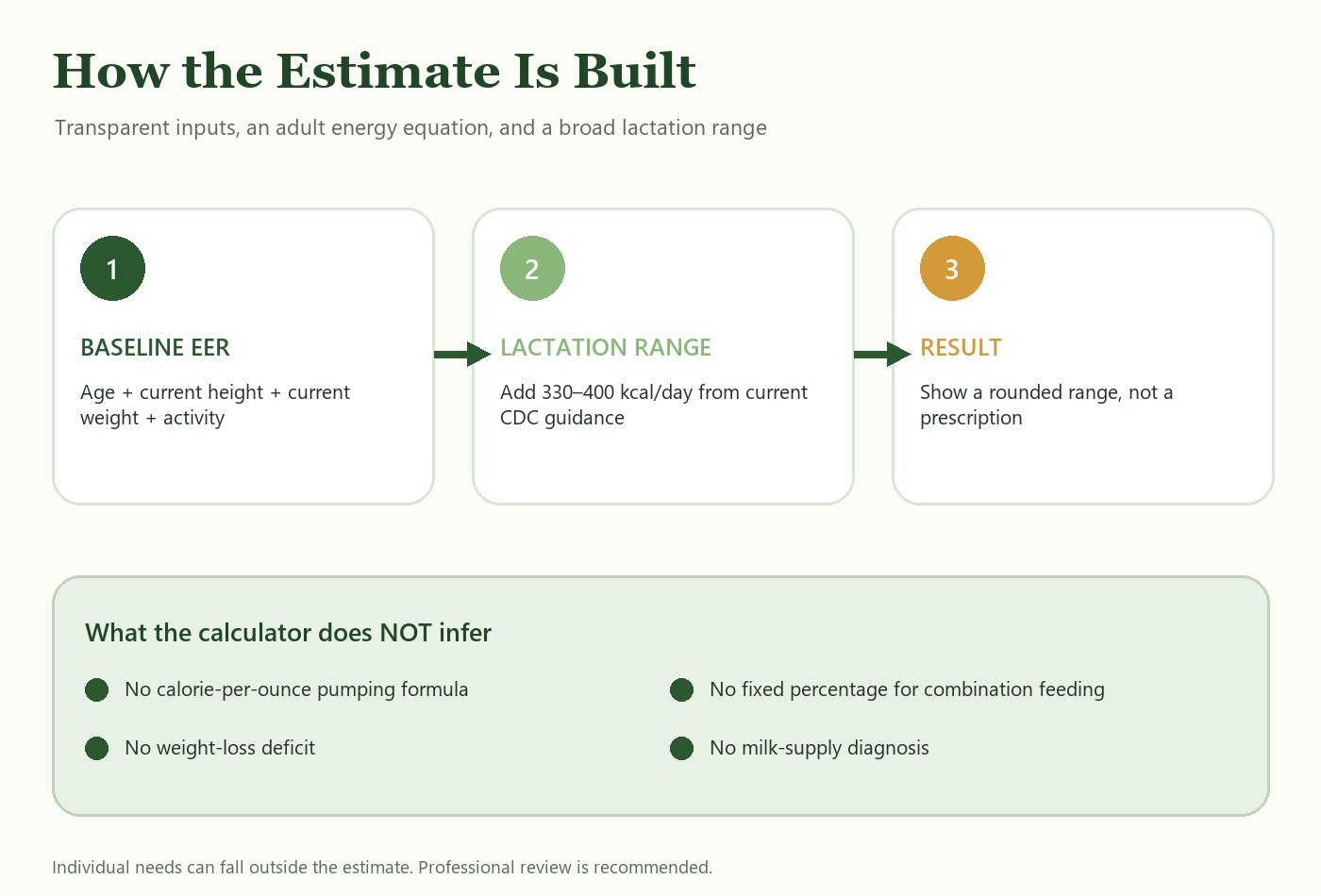
How the breastfeeding calorie calculator works
The calculator uses the 2023 National Academies adult female Estimated Energy Requirement equations. Those equations estimate total energy expenditure from age, height, current weight, and one of four physical activity categories.[3] They are population equations, so they cannot measure an individual metabolism.
| Activity category | Equation in kcal/day |
|---|---|
| Inactive | 584.90 − (7.01 × age) + (5.72 × height in cm) + (11.71 × weight in kg) |
| Low active | 575.77 − (7.01 × age) + (6.60 × height in cm) + (12.14 × weight in kg) |
| Active | 710.25 − (7.01 × age) + (6.54 × height in cm) + (12.34 × weight in kg) |
| Very active | 511.83 − (7.01 × age) + (9.07 × height in cm) + (12.56 × weight in kg) |
Why the result is a range
Current CDC guidance says well-nourished breastfeeding mothers generally need about 330–400 additional calories per day compared with what they consumed before pregnancy. It also says the amount varies with age, body mass index, activity, and whether feeding is exclusive or mixed.[2]
The calculator therefore adds 330 to 400 calories to the baseline EER and rounds results to the nearest 10 calories. It does not multiply calories by a self-reported percentage of breastfeeding, number of pumping sessions, or ounces pumped.
How this differs from the formal DRI lactation models
The 2023 report models the first six months with an exclusive-breastfeeding assumption and a net addition of about 400 calories per day. For months 7–12, it models partial breastfeeding with an energy cost of about 380 calories per day.[3] Those are population assumptions, not a way to calculate a precise personal need from a feeding label. After the first year, the report describes the energy cost as variable with child demand and maternal factors.[3]
How to interpret your result
Treat the breastfeeding calorie calculator result as a planning range. It can help compare meal patterns, discuss appetite changes, or prepare questions for a clinician. It cannot tell you exactly how much to eat on every day.
- Use the baseline as context: it is the equation’s estimate before the general lactation add-on.
- Use the range, not only its midpoint: daily appetite and activity vary.
- Do not treat it as a minimum: some people need more; a medical condition may also change the goal.
- Do not use it to diagnose low milk supply: milk production and infant growth require clinical and feeding assessment.
- Review trends with a professional: persistent fatigue, dizziness, rapid or unintentional weight change, food insecurity, feeding pain, or concerns about infant growth deserve support.
The National Academies notes that an individual’s actual requirement can vary considerably from an EER and recommends monitoring over time rather than assuming the prediction is exact.[4]
Exclusive breastfeeding, partial breastfeeding, and pumping
The breastfeeding calorie calculator keeps one broad range because feeding labels do not reveal an individual’s milk production or metabolic needs precisely.
Exclusive breastfeeding or chestfeeding
Exclusive feeding does not produce one fixed calorie requirement. Milk volume, infant age, maternal body stores, activity, sleep disruption, recovery, and individual metabolism vary. The calculator keeps the same broad range and does not claim that “exclusive” equals an exact number.
Partial or combination feeding
Partial breastfeeding may require less energy than an exclusive-feeding population model, but the difference is not reliably captured by a simple percentage. Formula volume does not reveal maternal milk production precisely, so the calculator does not subtract calories for combination feeding.
Mostly or exclusively pumping
Pumped volume is not a complete measure of milk production, and pumping efficiency varies by parent, pump, timing, and technique. A calorie-per-ounce formula would look precise without being dependable. Pumping context changes the explanation—not the output.
After 12 months
Milk production and feeding frequency often become more variable. The 2023 DRI report specifically notes that second-year energy cost depends on child demand and maternal factors.[3] Use the result only as a broad conversation starter after the first year.
Nutrition and hydration while breastfeeding
The breastfeeding calorie calculator estimates energy, not overall diet quality. Calories are only one part of nutrition. Current U.S. guidance emphasizes whole, nutrient-dense foods including protein foods, dairy or suitable alternatives, vegetables, fruits, healthy fats, and whole grains.[6] CDC guidance encourages a healthy, diverse diet and notes that needs for several micronutrients increase during lactation.[2]
A practical meal may combine:
- A protein source such as eggs, yogurt, beans, lentils, tofu, poultry, fish, or another preferred option
- A carbohydrate source such as oats, fruit, potatoes, rice, or whole-grain bread
- Vegetables or fruit
- A source of fat such as nuts, seeds, avocado, olive oil, or another culturally appropriate food
For realistic food ideas, link to a relevant recipe—not a restrictive postpartum diet. NutriQuora examples include the high-protein breakfast ideas and vegetable lentil soup recipe. Add context that portions may need to be larger during lactation.
Hydration
Keep water or another suitable drink available during feeds and pumping sessions. ACOG advises drinking plenty of fluids and drinking more when urine is dark yellow.[5] The calculator does not estimate fluid needs, and drinking excessive water is not presented as a way to guarantee milk supply.
What this calculator can and cannot account for
The breastfeeding calorie calculator includes only the variables named below and should not be read as a full nutrition or lactation assessment.
| It accounts for | It does not account for |
|---|---|
| Age, current height, current weight, and broad activity category | Measured resting metabolism or body composition |
| A general 330–400 calorie lactation range | Exact milk production, feeding frequency, latch, pump efficiency, or ounces expressed |
| Metric and US customary units | Pregnancy, twin or higher-order lactation, adolescent needs, or relactation |
| First-year DRI context and a second-year caution | Illness, recovery, medications, thyroid conditions, diabetes, kidney disease, or eating disorders |
| A tailored limitation note by feeding context | A personalized calorie prescription or weight-change plan |
People often search for “calorie calculator breastfeeding” when they want one definitive number. A range is more honest because both the baseline equation and the lactation adjustment contain uncertainty.
Medical disclaimer
The breastfeeding calorie calculator provides general educational estimates for adults. It is not medical advice, a diagnosis, a calorie minimum, or a substitute for care from an obstetrician, primary-care clinician, pediatric clinician, registered dietitian, or qualified lactation professional. Seek individualized care for concerns about milk supply, infant growth, postpartum recovery, rapid or unintentional weight change, restrictive eating, dizziness, severe fatigue, dehydration, or any medical condition.
Frequently asked questions
How many extra calories are generally recommended while breastfeeding?
CDC guidance says well-nourished breastfeeding mothers generally need an additional 330–400 calories per day compared with pre-pregnancy intake, while noting that individual needs differ.[2]
Is the breastfeeding calorie calculator exact?
No. It combines a population equation with a broad lactation range. Metabolism, activity classification, milk production, recovery, body stores, and health conditions can move actual needs outside the estimate.
Why can two “calories for breastfeeding calculator” results differ?
Tools may use different baseline equations, activity definitions, body measurements, or lactation additions. A trustworthy calculator should name its formula, units, assumptions, source dates, and limitations.
Does exclusive breastfeeding automatically mean I should use the high end?
Not automatically. Exclusive feeding can affect energy needs, but the calculator cannot measure milk volume or individual metabolism. It does not assign a precise number from the feeding label.
Should partial breastfeeding reduce the result by a fixed percentage?
No fixed reduction is applied. Combination-feeding patterns and milk production vary, and formula intake is not a precise inverse measure of maternal milk production.
Can I calculate calories from the amount I pump?
Not reliably with this tool. Pumped volume can differ from total milk production and depends on equipment, timing, technique, and individual response.
Can I use this calculator for postpartum weight loss?
It was not designed to prescribe a calorie deficit. Discuss intentional weight loss with a qualified clinician or maternal-nutrition registered dietitian, especially early postpartum or when supply, recovery, mental health, or infant growth is a concern.
What if I am hungry above the estimate?
The estimate is not a ceiling. Appetite and needs vary. Persistent hunger, fatigue, dizziness, rapid weight change, or feeding concerns are reasons to seek individualized support rather than force intake to match the calculator.
Does drinking more water increase breast milk?
This calculator does not make that claim. Keep fluids available, respond to thirst, and seek care for dehydration or supply concerns. ACOG advises more fluid when urine is dark yellow.[5]
Who should not use this calculator without professional guidance?
People under 19, currently pregnant, managing a medical condition, receiving nutrition therapy, feeding multiples, recovering from an eating disorder, losing weight unintentionally, or concerned about infant growth or milk supply should use individualized guidance.
Authorship, review, and update record
Do not replace “not yet medically reviewed” with a reviewer’s name until that person has reviewed the formula, input ranges, feeding-language choices, contraindications, and all health claims. Follow the NutriQuora editorial and corrections policy.
Sources
- Google Search Central, Creating helpful, reliable, people-first content — transparency, authorship, sourcing, and quality principles used for the page.
- CDC, Maternal Diet and Breastfeeding — current calorie-range, variability, diet, and micronutrient context.
- National Academies of Sciences, Engineering, and Medicine, Dietary Reference Intakes for Energy, Chapter 5 — 2023 adult EER equations and lactation models.
- National Academies, 2023 DRI for Energy Highlights — intended use and individual uncertainty.
- American College of Obstetricians and Gynecologists, Breastfeeding Your Baby — maternal diet and hydration guidance.
- Office of Disease Prevention and Health Promotion, Dietary Guidelines for Americans, 2025–2030 — overall food-pattern context.