
A sore stomach can turn breakfast into a guessing game. Coffee may feel too sharp. Toast may feel too dry. A rich meal may feel like too much.
An oatmeal breakfast gives you another choice. You can cook it very soft, keep the flavor mild, and change the toppings to fit your own comfort.
This guide starts with one simple pot of oats. Then it turns that pot into seven different bowls, from banana and pear to egg and squash.
Quick answer: An oatmeal breakfast may be a soft, warm meal when ulcer symptoms make eating hard. Cook rolled or quick oats with extra liquid until creamy. Add a soft fruit, egg, tofu, yogurt, or smooth seed butter if you tolerate it. Oatmeal does not heal an ulcer. NIDDK says no special diet is proven to prevent or treat peptic ulcers.[1]
Editorial note: NutriQuora checked this page against U.S. health and food data sources. A doctor has not checked it. These bowls are food ideas, not ulcer care. Read our editorial standards.
Table of contents
- Quick recipe facts
- Basic creamy oatmeal
- How to make oatmeal softer
- Seven oatmeal breakfast bowls
- Oatmeal topping guide
- Oat nutrition
- What treats an ulcer
- When to get urgent help
- Frequently asked questions
Oatmeal breakfast quick facts
| Detail | Answer |
|---|---|
| Prep time | 2 minutes |
| Cook time | 5 to 8 minutes |
| Yield | 1 bowl |
| Dry oats | 1/2 cup or about 40 grams |
| Liquid | 1 to 1 1/4 cups |
| Best texture | Soft, creamy, and moist |
| Ulcer treatment | No |
Basic creamy oatmeal recipe
Use this mild base for all seven oatmeal breakfast bowls.
Ingredients
- 1/2 cup old-fashioned rolled oats or quick oats
- 1 cup water, milk, lactose-free milk, or a fortified plant drink
- Up to 1/4 cup more liquid for a softer bowl
- Small pinch of salt, optional
Five easy steps
- Put the oats and one cup of liquid in a small pan.
- Bring the mix to a light simmer.
- Turn the heat to low.
- Stir until the oats are very soft and creamy.
- Add more liquid, one spoon at a time, until the texture feels right.
Let the bowl cool before eating. A very hot meal may be hard to enjoy when your stomach already hurts.
Microwave method
- Use a large microwave-safe bowl.
- Mix the oats and liquid.
- Heat for 90 seconds.
- Stir, then heat in 30-second rounds until soft.
- Watch the bowl because oatmeal can rise and spill.
How to make an oatmeal breakfast softer
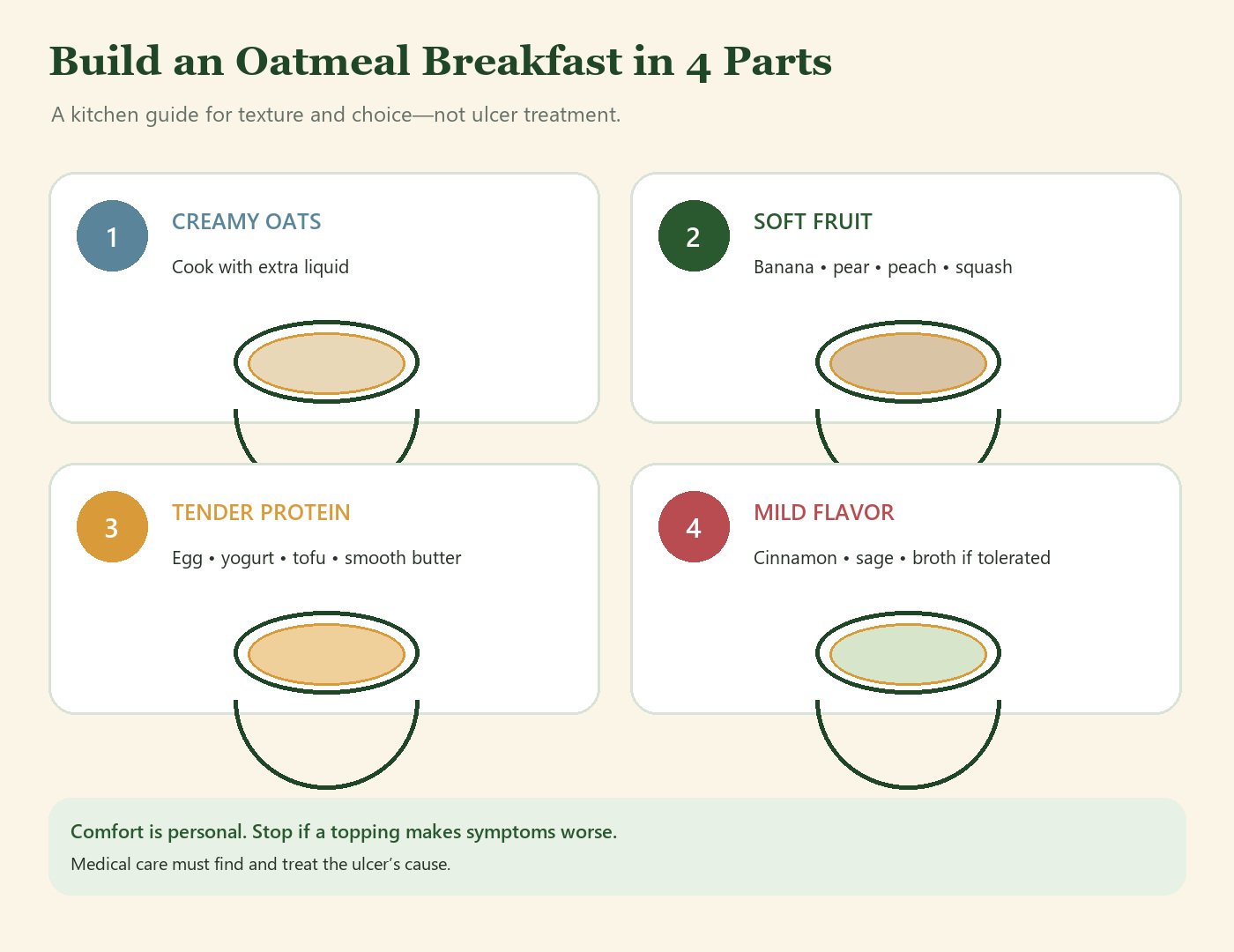
A soft bowl is about texture, not a cure.
Try these steps:
- Choose quick oats for a finer texture.
- Cook rolled oats a few minutes longer.
- Add extra water, milk, or broth.
- Mash fruit before adding it.
- Cook pear, peach, apple, carrot, or squash until tender.
- Use smooth nut or seed butter instead of chopped nuts.
- Cut egg, tofu, or chicken into very small pieces.
- Eat slowly and stop when comfortably full.
MedlinePlus describes a bland diet as soft, mild, and lower in fiber. It also says a care provider should guide when other foods are added back.[4]
That does not mean every person with an ulcer needs a bland diet. NIDDK does not recommend one special diet to treat peptic ulcers.[1]
Seven oatmeal breakfast bowls
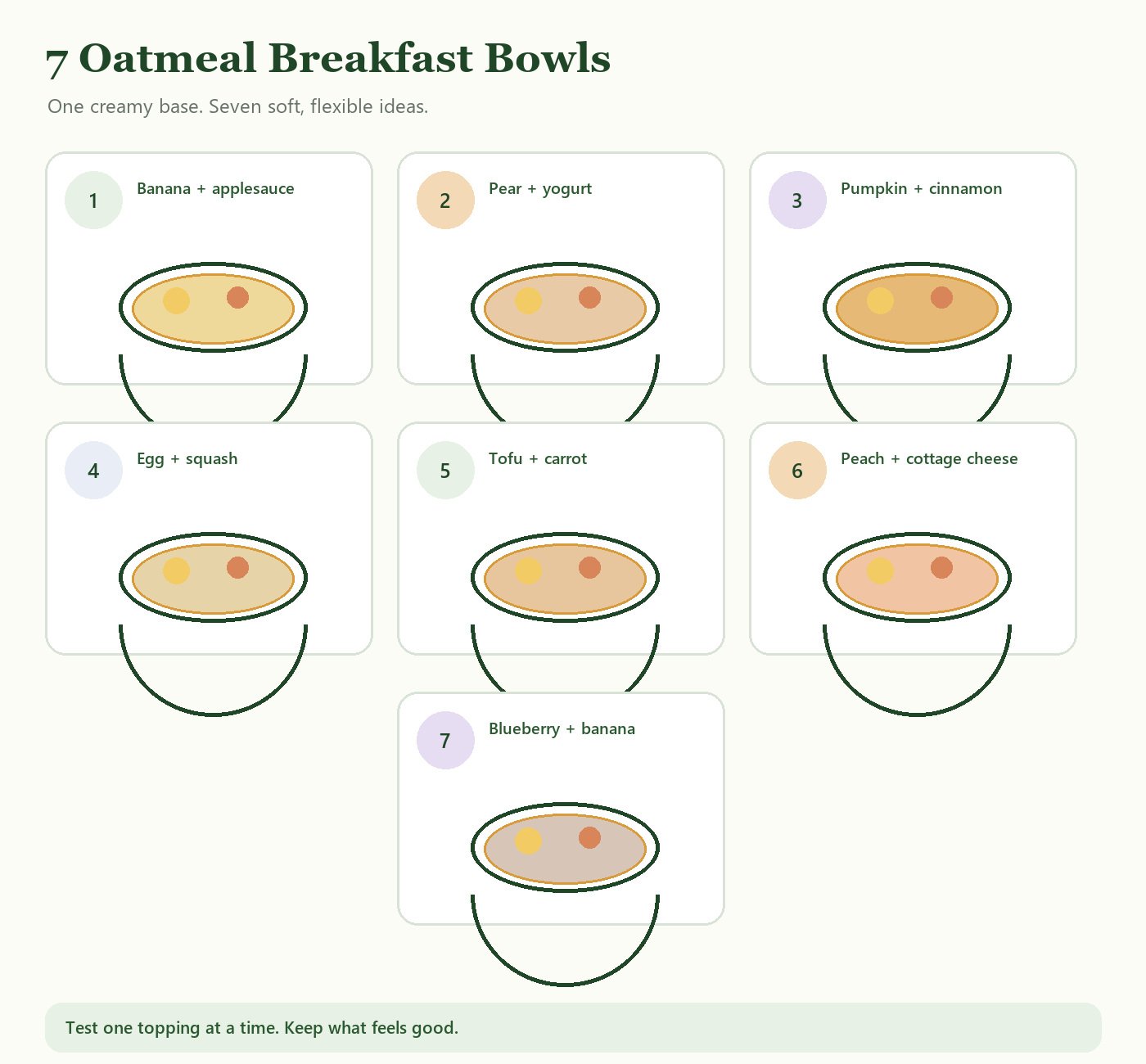
Choose one bowl at a time. Keep the toppings simple so you can learn what feels good for you.
1. Banana applesauce oatmeal
You need:
- 1 bowl basic creamy oatmeal
- 1/2 ripe banana
- 1/4 cup unsweetened applesauce
- Pinch of cinnamon, optional
Steps:
- Mash the banana.
- Stir half into the oatmeal.
- Add the applesauce.
- Spoon the rest of the banana on top.
Easy swap: Use mashed canned pear instead of applesauce.
2. Soft pear yogurt oatmeal
You need:
- 1 bowl basic creamy oatmeal
- 1 ripe pear, peeled and diced
- 1/3 cup plain yogurt
- 1 teaspoon maple syrup, optional
Steps:
- Put the pear in a small pan with two tablespoons of water.
- Cover and cook until very soft.
- Mash the pear.
- Add it to the oatmeal.
- Add yogurt after the bowl cools a little.
Dairy-free swap: Use fortified soy yogurt.
3. Pumpkin cinnamon oatmeal
You need:
- 1 bowl basic creamy oatmeal
- 1/3 cup plain pumpkin puree
- 1/4 cup milk or fortified plant drink
- Pinch of cinnamon, optional
- 1 teaspoon smooth seed butter, optional
Steps:
- Stir pumpkin into the hot oatmeal.
- Add milk until creamy.
- Add cinnamon if you tolerate it.
- Add seed butter only if it is safe for you.
Easy swap: Use mashed cooked squash or sweet potato.
4. Savory oatmeal with egg and squash
You need:
- 1 bowl basic oatmeal cooked with water or low-salt broth
- 1 egg
- 1/3 cup cooked squash, mashed
- 1 tablespoon milk or broth
- Pinch of dried sage, optional
Steps:
- Beat the egg with milk or broth.
- Cook it over low heat until fully done and soft.
- Stir the squash into the oatmeal.
- Cut the egg into small pieces.
- Add the egg on top.
Egg-free swap: Use 1/2 cup soft tofu.
5. Tofu carrot savory oatmeal
You need:
- 1 bowl basic oatmeal cooked with water or low-salt broth
- 1/2 cup soft tofu
- 1/3 cup cooked carrot, mashed
- 1 teaspoon low-sodium soy sauce, optional
Steps:
- Warm the tofu gently.
- Mash it with a fork.
- Stir the carrot into the oatmeal.
- Add tofu on top.
- Add soy sauce only if it suits you.
Soy-free swap: Use a soft, fully cooked egg.
6. Peach cottage cheese oatmeal
You need:
- 1 bowl basic creamy oatmeal
- 1/2 cup canned peaches in juice, drained
- 1/3 cup cottage cheese
- Pinch of cinnamon, optional
Steps:
- Cut the peaches into small pieces.
- Mash them with a fork.
- Stir them into the oatmeal.
- Add cottage cheese after the bowl cools a little.
Dairy-free swap: Use soft tofu blended smooth.
7. Blueberry banana oatmeal
You need:
- 1 bowl basic creamy oatmeal
- 1/3 cup blueberries
- 1/2 ripe banana
- 1 teaspoon smooth peanut or seed butter, optional
Steps:
- Put the berries in a small pan with one tablespoon of water.
- Cook until they burst and soften.
- Mash the banana.
- Stir the banana and cooked berries into the oatmeal.
- Add smooth butter only if it is safe for you.
Seed-sensitive swap: Press the cooked berries through a fine strainer or use applesauce.
Oatmeal toppings: test, do not fear
Oatmeal toppings can change flavor, texture, fiber, fat, and portion size.
Soft fruit choices
- Mashed banana
- Unsweetened applesauce
- Cooked pear
- Canned peach in juice
- Pumpkin puree
- Mashed squash
- Cooked blueberries
Tender protein choices
- Plain yogurt
- Cottage cheese
- Fully cooked egg
- Soft tofu
- Smooth peanut butter
- Smooth seed butter
Moisture choices
- Water
- Milk
- Lactose-free milk
- Fortified soy drink
- Low-salt broth for savory oatmeal
- Plain yogurt after cooking
Flavors to test carefully
- Cinnamon
- Ginger
- Lemon
- Cocoa
- Coffee
- Hot pepper
- Tomato
These foods do not cause every ulcer. They may bother some people and feel fine for others.
Test one change at a time. Write down the amount and how you felt. A personal symptom trigger is not the same as an ulcer cause.
Oats and nutrition
USDA FoodData Central identifies its reference ingredient as whole-grain, old-fashioned rolled oats.[6]
Using that record, 40 grams of dry oats provides an estimated:
- 153 calories
- 5.4 grams protein
- 27.5 grams carbohydrate
- 2.4 grams fat
- 4.2 grams measured dietary fiber
- 3 grams beta-glucan[6]
These numbers describe the oats before cooking. Brands and serving sizes can change the final bowl. Milk, fruit, egg, yogurt, tofu, and other toppings change it too.
Fiber is not proof that oatmeal heals an ulcer. Food and medical care do different jobs.
If you have not eaten much fiber, begin with a smaller bowl. Add more slowly if it feels good. Ask your care team for help if you can eat only a few foods.
Allergy and label check
Some bowls use milk, egg, soy, peanut, or tree nuts. Oats can also touch wheat during growing or packing.
FDA names nine major food allergens: milk, eggs, fish, shellfish, tree nuts, peanuts, wheat, soy, and sesame.[5]
Read labels and prevent cross-contact. If you need gluten-free oats, choose a product labeled gluten-free. Use only toppings that are safe for you.
What actually treats a peptic ulcer?
An oatmeal breakfast does not remove the cause of an ulcer.
NIDDK says doctors treat the cause so the ulcer can heal and is less likely to return.[2]
Care may include:
- Testing for H. pylori
- Antibiotics when H. pylori is found
- A proton pump inhibitor or another acid-lowering medicine
- Reviewing aspirin, ibuprofen, naproxen, or another NSAID
- Follow-up testing when advised
Do not stop prescribed medicine on your own. Take every antibiotic dose as directed.
For more options, see NutriQuora’s unchanged soft food recipes and 7-day meal plan for ulcers.
When to get urgent help
Get urgent medical help if:
- You vomit red blood
- Your vomit looks like coffee grounds
- Your stool is black, tarry, or bloody
- You have sudden or severe stomach pain that will not stop
- You feel faint or very dizzy
- Your pulse becomes fast
NIDDK lists these as signs of a possible ulcer problem that needs fast care.[3]
Do not make oatmeal and wait at home when bleeding or severe pain is present.
Frequently asked questions
Is oatmeal good for stomach ulcers?
Oatmeal can be a soft breakfast and a source of fiber. It is not a proven ulcer treatment. NIDDK says no special diet is proven to prevent or treat peptic ulcers.[1]
Can oatmeal heal an ulcer?
No. Oatmeal cannot replace H. pylori testing, antibiotics, acid medicine, or other care for the cause.
Is oatmeal easy to digest?
That depends on the person. Soft, well-cooked oats may feel comfortable for some people. Others may notice fullness, gas, or pain after a large or high-fiber bowl.
Are quick oats better than rolled oats?
Quick oats have a finer texture and cook faster. Rolled oats can also become very soft when cooked longer with extra liquid.
Can I use milk in oatmeal?
Yes, if you tolerate it. Milk does not heal an ulcer. Try lactose-free milk or a fortified plant drink if regular milk causes symptoms.
Can I add banana?
Yes. A ripe mashed banana adds softness and sweetness. Skip it if banana is not safe or comfortable for you.
Can I make savory oatmeal?
Yes. Cook oats with water or low-salt broth. Add a soft egg, tofu, squash, or carrot. Keep spices mild at first.
Should I avoid all oatmeal toppings?
No. Test one topping at a time. Keep what feels good and pause what causes symptoms more than once.
Is instant oatmeal okay?
Plain instant oatmeal can work. Read the label. Flavored packs may have more added sugar or strong flavor. They may also have milk, nuts, soy, or other allergens.
What if oatmeal makes me feel worse?
Stop eating it and choose another meal. Tell a clinician if pain or nausea keeps you from eating. Get help too if you vomit or feel full very fast.
Bottom line
An oatmeal breakfast can be warm, soft, and easy to change. Start with creamy oats, then add one soft topping and one tender protein if you wish.
The seven bowls are flexible ideas, not strict rules. Your comfort may change from day to day.
Use food to support comfort and nutrition. Use medical care to find and treat the cause of an ulcer.