
A 1949 paper made cabbage juice sound almost magical. Thirteen people drank it, and their ulcers seemed to heal faster than old reports said they should.
That headline is easy to share. The full story is less simple.
The study was tiny. It did not use a modern control group. It came decades before today’s H. pylori tests, antibiotics, and acid medicines.
This guide shows you how to juice cabbage safely. It also checks the old study and explains why it does not prove a cure. You will learn when ulcer signs need medical care.
Quick answer: Juicing cabbage makes a raw vegetable drink. One old study in 13 people reported fast ulcer healing.[4] The study does not meet modern standards. NIDDK says no special diet is proven to prevent or treat ulcers.[1] Drink cabbage juice only as food. Do not use it in place of tests, medicine, or urgent care.
Editorial note: NutriQuora checked this page against U.S. health sources and the 1949 paper. A doctor has not checked it. This recipe is food, not ulcer care. Read our editorial standards.
Table of contents
- Quick recipe facts
- Cabbage juice recipe
- How to juice cabbage
- No-juicer method
- What the ulcer study found
- Why the study does not prove a cure
- Cabbage nutrition
- Food and medicine safety
- When to get medical help
- Frequently asked questions
Quick cabbage-juice facts
| Detail | Answer |
|---|---|
| Prep time | 10 minutes |
| Yield | About 8 to 10 fluid ounces |
| Main ingredient | About 300 grams raw green cabbage |
| Texture | Thin with fine vegetable pulp |
| Taste | Fresh, grassy, and slightly sharp |
| Pasteurized | No; homemade juice is raw |
| Ulcer treatment | No |
Juicing cabbage: a simple recipe
This is a food-size recipe for juicing cabbage. It does not copy the large daily amounts used in old ulcer research.
Ingredients
- About 1/2 small green cabbage (300 grams)
- 1/2 small cucumber (about 100 grams), optional
- 1/4 to 1/2 cup cold water, only for the blender method
- 1 teaspoon lemon juice, optional for taste
The cucumber makes the drink milder and adds liquid. Leave it out if you want plain cabbage juice.
Lemon is optional. Acidic food does not cause every ulcer, but it may bother some people. Skip it if it is a known trigger.
Equipment
- A juicer or strong blender
- A clean knife and cutting board
- A produce brush for the cabbage core, if needed
- A fine mesh strainer or clean nut-milk bag for the blender method
- A clean glass with a lid
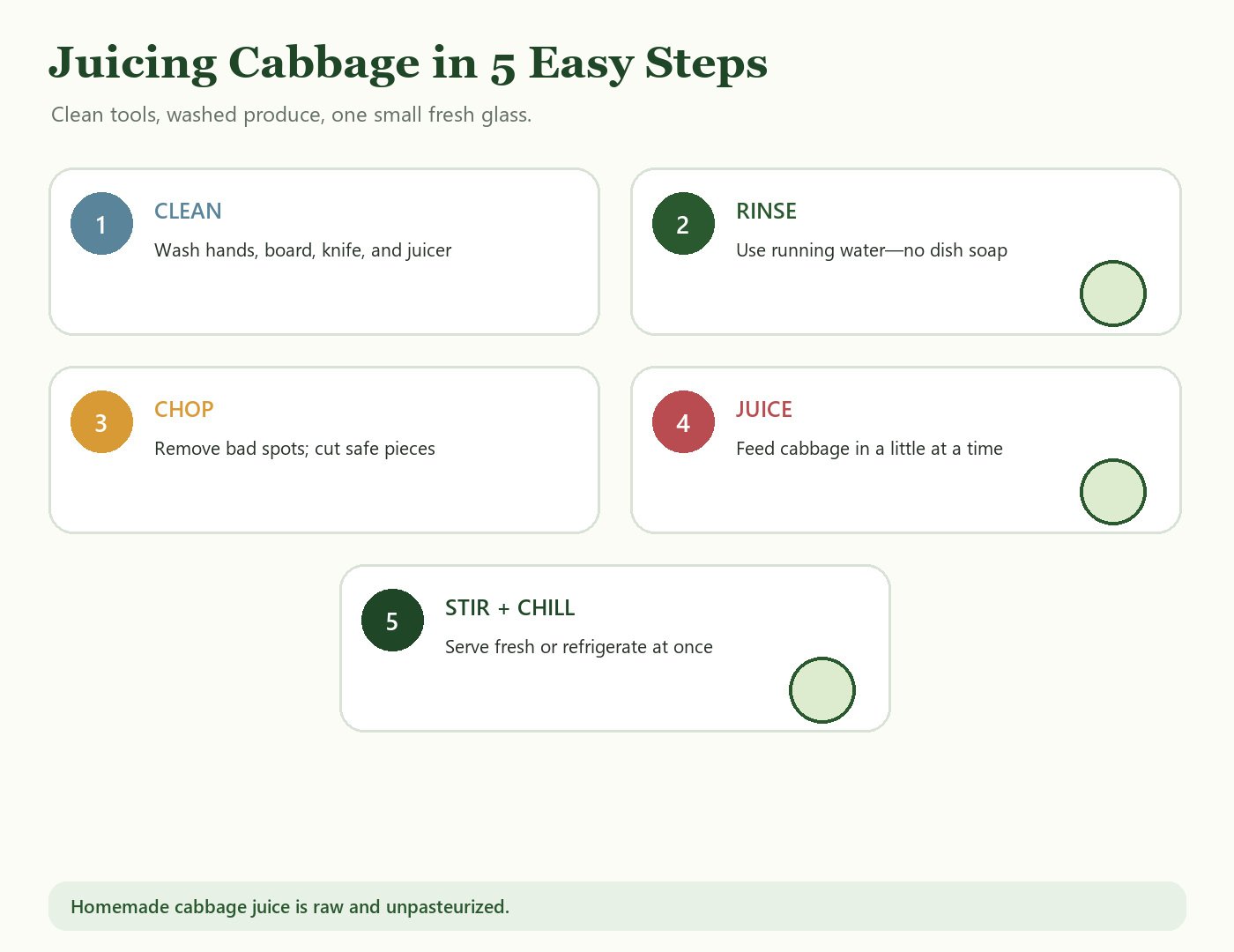
Juicing cabbage in 5 easy steps
Step 1: Wash your hands and tools
Wash your hands with soap and water.
Clean the knife, board, juicer parts, glass, and counter. Keep raw cabbage away from raw meat and dirty tools.
Step 2: Rinse the cabbage
Remove the loose outer leaves.
Rinse the cabbage under cool running water. Rub the surface and rinse between the leaves you will use.
FDA advises washing produce under running water. It does not recommend soap, detergent, or commercial produce wash.[5]
Step 3: Cut the cabbage
Cut out any bruised or rotten part.
Slice the cabbage into pieces that fit your juicer. Cut the cucumber too, if using it.
Do not force a large hard piece into a small feed tube.
Step 4: Juice
Feed the cabbage into the machine a little at a time.
Alternate cabbage and cucumber so the machine does not clog. Stop and unplug the juicer before clearing a jam.
The amount of juice will change with the cabbage and the machine.
Step 5: Stir and serve
Stir the juice. Add lemon only if you tolerate it.
Pour one small glass and drink it fresh. Do not treat one glass as a dose or a cure.
Juicing cabbage without a juicer
Step 1: Chop small
Cut 300 grams of washed cabbage into small pieces.
Step 2: Add water
Put the cabbage in a strong blender. Add 1/4 cup cold water.
Add another 1/4 cup only if the blades cannot move.
Step 3: Blend
Blend until the mix looks very fine.
Stop and scrape down the sides with the blender turned off.
Step 4: Strain
Pour the mix through a fine strainer or clean nut-milk bag.
Press gently. Keep some pulp if you prefer more texture.
Step 5: Serve
Drink the juice right away or cover and chill it at once.
A blender drink keeps more pulp than clear juicer juice. Whole cabbage keeps all the pulp. Juicing cabbage is not the same as eating the whole leaf.
How to make cabbage juice taste better
Raw cabbage juice can taste strong. Try one mild change at a time.
- Add cucumber for a cleaner taste
- Chill the cabbage before juicing
- Serve over ice
- Add one small mint leaf
- Dilute the glass with cold water
- Add a teaspoon of lemon only if it does not cause pain
Do not hide the taste with a large amount of sugar. The goal is a vegetable drink, not a sweet soda.
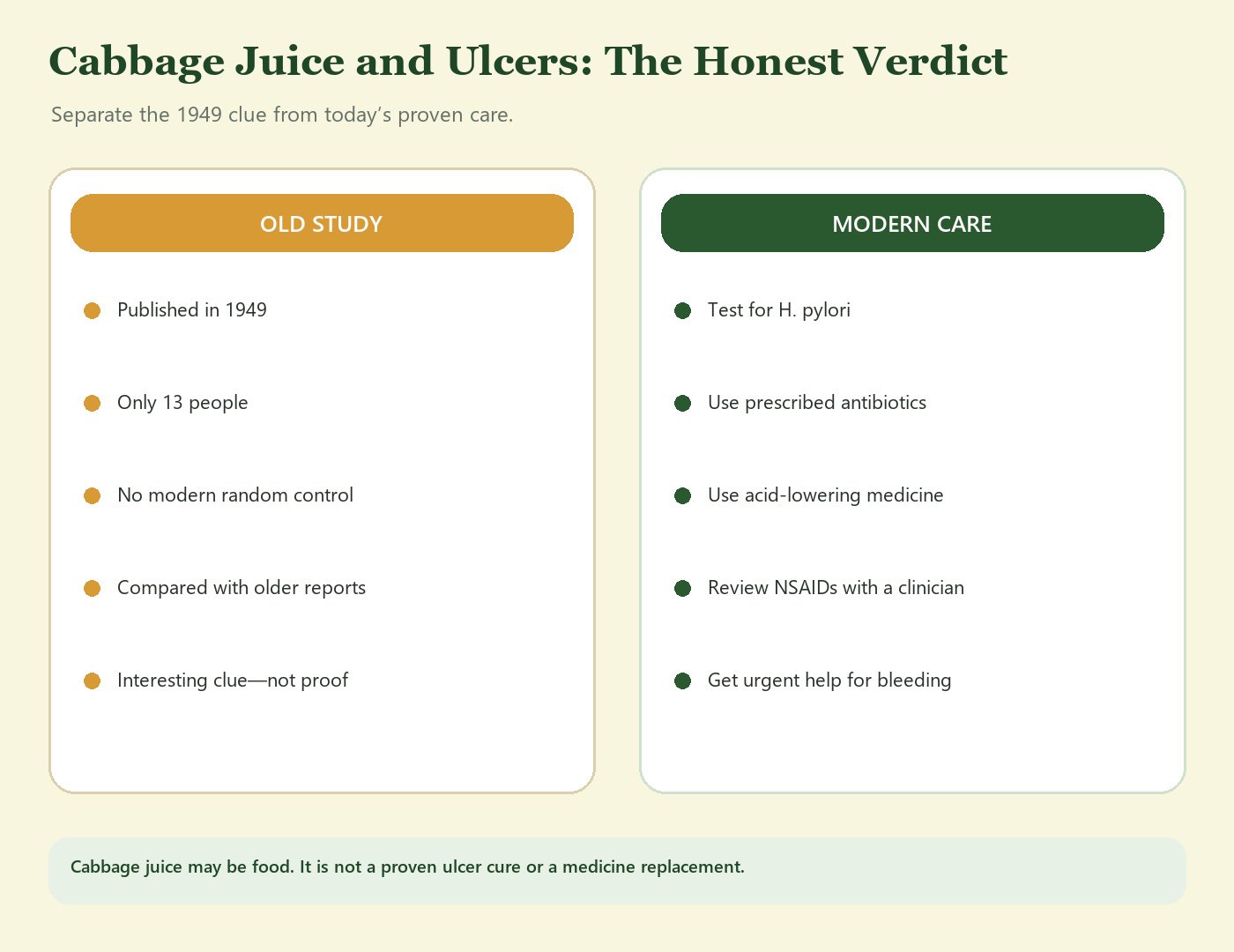
Juicing cabbage and the old ulcer study
The famous study was published in 1949.
It included 13 people with peptic ulcers who received fresh cabbage juice.[4]
The paper reported:
- Seven people with duodenal ulcers had an average healing time of 10.4 days.
- The authors compared that with 37 days in 62 people from earlier published reports.
- Six people with gastric ulcers had an average healing time of 7.3 days.
- The authors compared that with 42 days in six people from older reports.[4]
Those numbers sound dramatic. They do not prove that the juice caused the healing.
What was “vitamin U”?
The old paper called a possible anti-ulcer factor “vitamin U.”[4]
That was a historical research name. The study did not establish a modern treatment dose. It also did not show that a home juice recipe can replace today’s ulcer care.
Why the study does not prove cabbage juice cures ulcers
1. Only 13 people took part
A small group can give an early clue. It cannot tell us how most people will respond.
2. There was no modern control group
The authors compared their patients with older reports. They did not place people at random into a juice group and a matching control group.
3. The paper is from 1949
Doctors did not yet have today’s understanding of H. pylori. Modern acid drugs did not exist.
4. Current guidance does not name cabbage juice as treatment
NIDDK says no special diet is proven to cause, stop, or treat ulcers.[1]
Doctors treat the cause. H. pylori germs often need two or more antibiotics and a drug that lowers stomach acid.[2]
5. We do not have a proven home dose
The old paper does not make one glass size a safe or effective treatment. More juice is not automatically better.
The honest conclusion is simple: the old study is interesting history, not proof of a modern cure.
What is in raw cabbage?
USDA FoodData Central lists these values for 100 grams of whole raw cabbage:
- 25 calories
- 1.28 grams protein
- 5.8 grams carbohydrate
- 2.5 grams fiber
- 36.6 milligrams vitamin C
- 76 micrograms vitamin K
- 170 milligrams potassium[8]
These are whole-cabbage values, not a lab test of this juice.
A juicer removes much of the pulp. The fiber and nutrients in your glass will vary. The cabbage, machine, juice yield, and amount of pulp all matter.
Juice and whole cabbage are not the same food. Whole cabbage keeps all its fiber and needs chewing.
Cabbage juice safety
Wash produce well
FDA says bacteria on raw fruit and vegetables can enter fresh juice.[6]
Wash cabbage under running water. Do not wash it with dish soap.[5]
Use clean hands, tools, and containers.
Homemade juice is unpasteurized
Juicing cabbage at home makes a drink that is not heat-treated to kill germs.
FDA warns that untreated juice can carry harmful bacteria. Untreated juice can be more risky for some people.[6] This includes children, older adults, pregnant people, and people with weak immune systems.
People in these groups should ask a clinician about raw home juice. A heat-treated product is the safer choice when one is sold.
Keep it cold
Drink fresh juice right away when possible.
If you save it, cover and refrigerate it at once. Discard juice that sat warm for a long time, smells wrong, or looks spoiled.
Do not keep topping up the same old jar for several days.
Warfarin and vitamin K
Cabbage contains vitamin K.[8]
Vitamin K can affect how warfarin works. MedlinePlus tells people taking warfarin to keep vitamin K intake steady.[7] Talk with your doctor before a big diet change.
Do not start juicing cabbage in large amounts without checking your warfarin plan.
Stomach comfort
Cabbage juice can cause gas, fullness, or a strong taste for some people.
Start with a few sips if you want to test tolerance. Stop if pain or nausea gets worse.
This is not a clinical dose.
What actually treats a peptic ulcer?
Food does not remove the most common causes of peptic ulcers.
NIDDK explains that doctors treat the cause to help the ulcer heal and stop it from returning.[2]
Care may include:
- Testing for H. pylori
- Antibiotics when H. pylori is present
- A proton pump inhibitor or another acid-reducing medicine
- Reviewing aspirin, ibuprofen, naproxen, or another NSAID with a clinician
- Follow-up testing when advised
Do not stop prescribed medicine on your own. Finish antibiotics exactly as directed.
For practical meal ideas, see NutriQuora’s unchanged 7-day meal plan for ulcers and bland diet food list.
When to get urgent medical help
Get urgent help if:
- You vomit red blood
- Your vomit looks like coffee grounds
- Your stool is black, tarry, or bloody
- You have sudden or severe stomach pain that does not stop
- You feel faint or very dizzy
- Your pulse becomes fast
NIDDK lists these as signs of a possible ulcer complication.[3]
Do not drink cabbage juice and wait at home when bleeding or severe pain is present.
Frequently asked questions
Does cabbage juice heal stomach ulcers?
We do not have strong modern proof that it does. One 1949 study in 13 people reported fast healing, but it lacked a modern randomized control group.[4]
How much cabbage juice did the old study use?
The old study used fresh cabbage juice as care. Do not copy its plan as a home dose. There is no proven modern dose for ulcer healing.
What is vitamin U?
“Vitamin U” was the old paper’s name for a possible anti-ulcer factor in cabbage.[4] The name does not make cabbage juice a proven vitamin treatment.
Can cabbage juice kill H. pylori?
A home cabbage drink is not a proven way to remove H. pylori. NIDDK says doctors use a mix of medicines for the germs.[2] This often includes antibiotics and a drug that lowers stomach acid.
Can I drink cabbage juice with ulcer medicine?
Food and medicine needs differ. Ask a pharmacist or clinician about your own medicines. Do not replace or stop a drug that was prescribed for you.
Is cabbage juice acidic?
Its taste and acid level can vary. Skip lemon or another sour add-on if it causes pain.
Is cabbage juice better than whole cabbage?
Not always. Whole cabbage keeps its fiber and pulp. Juice may be easier to sip, but it is not the same as whole cabbage.
Can I make cabbage juice in a blender?
Yes. Blend chopped cabbage with a little cold water, then strain it. Keep some pulp if you want more texture.
How long does fresh cabbage juice last?
Fresh is best. Cover and chill it at once if you save it. Discard it if it sat warm, smells wrong, or looks spoiled.
Who should avoid unpasteurized juice?
FDA says children, older adults, pregnant people, and people with weak immune systems face more risk from untreated juice.[6] Ask a clinician or choose pasteurized juice.
Bottom line
Juicing cabbage is an easy kitchen method. The old ulcer study is interesting, but it is not proof of a cure.
Wash the cabbage, use clean tools, make a small food-size glass, and keep the juice cold.
Most important, use medical testing and treatment for an ulcer’s cause. Do not let a green drink delay antibiotics, acid medicine, or urgent care.
Sources
- [1] NIDDK: Eating, Diet, and Nutrition for Peptic Ulcers
- [2] NIDDK: Treatment for Peptic Ulcers
- [3] NIDDK: Symptoms and Causes of Peptic Ulcers
- [4] Cheney 1949: Fresh cabbage juice and peptic ulcers
- [5] FDA: Selecting and Serving Produce Safely
- [6] FDA: What You Need to Know About Juice Safety
- [7] MedlinePlus: Warfarin
- [8] USDA FoodData Central: Cabbage, raw