Searching for 2-month metformin weight loss results usually means you want one clear number. The honest answer is that there is no reliable universal target for the first 60 days. Some people lose a small amount, some see no meaningful change, and others stop or adjust treatment because of side effects.
That uncertainty is not a failure. Metformin is prescribed for medical reasons such as type 2 diabetes, gestational diabetes and PCOS—not as a promise that everyone will lose a specific number of pounds by week eight.[1][2]
Quick answer: At two months, the most useful questions are whether you are taking metformin as prescribed, whether side effects are manageable, whether the condition it was prescribed for is improving, and whether your weight trend—not one weigh-in—is moving in a clinically appropriate direction. A fixed claim such as “everyone loses 4 to 6 pounds” is not supported by good evidence.
Editorial note: This article was updated to replace fixed weight-loss promises with evidence-based expectations. It is educational, not individualized medical advice, and has not been medically reviewed.
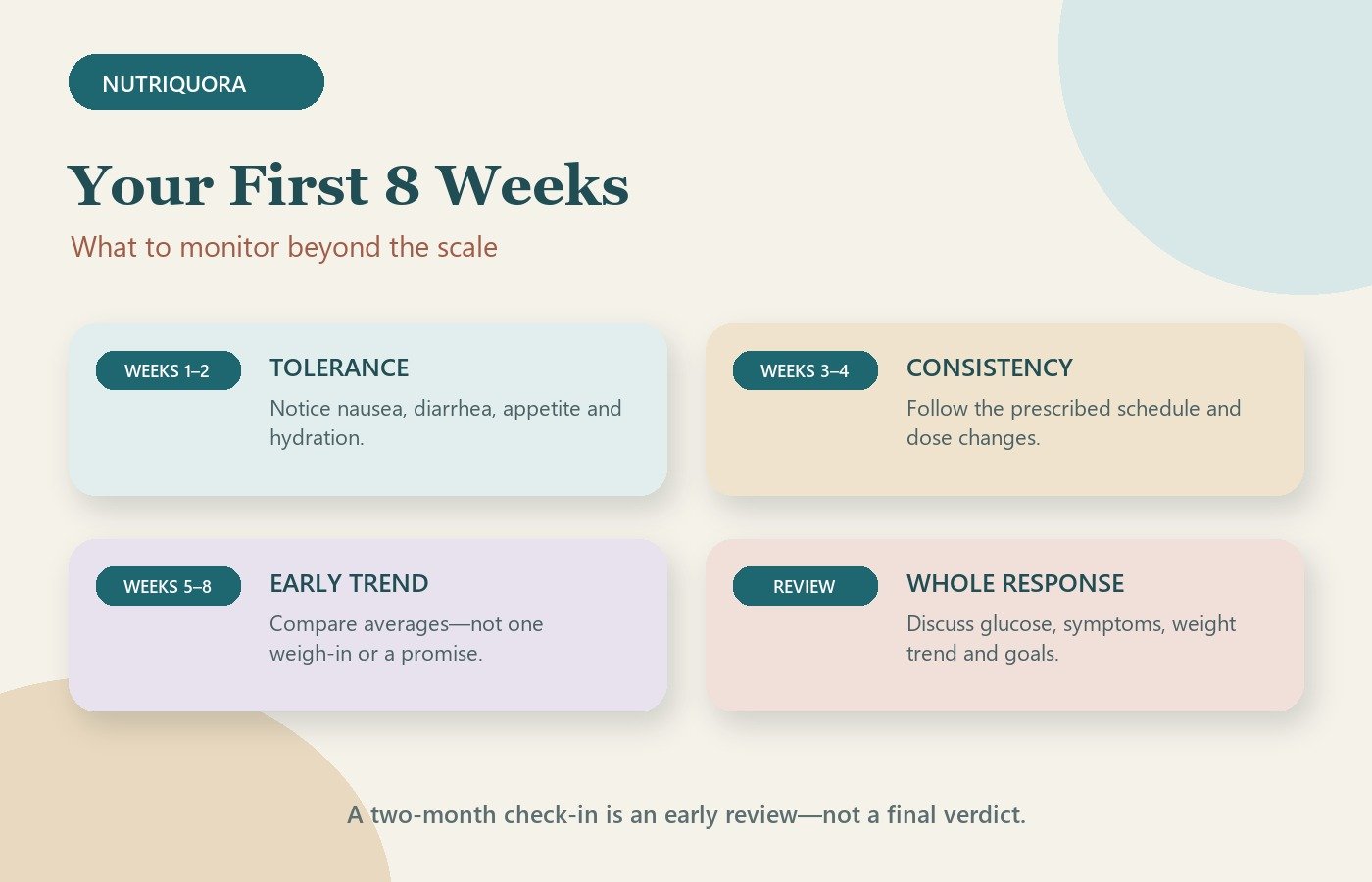
What 2-month metformin weight loss results can—and cannot—tell you
An eight-week check-in can show an early trend. It cannot tell you your final response to treatment.
During the first weeks, a prescriber may start with a lower dose and increase it gradually. MedlinePlus states that a clinician may raise the dose no more often than every one to two weeks, while the NHS notes that the amount and schedule depend on why metformin is being taken and the person’s age.[1][2]
That means two people comparing 2-month metformin weight loss results may not have received the same formulation, dose, titration schedule or treatment plan.
What you may be able to assess by week eight
- Whether you can take the prescribed dose consistently
- Whether nausea, diarrhea, abdominal discomfort or appetite changes are settling
- Whether your clinician’s blood-glucose or metabolic targets are moving in the right direction
- Whether your average weight trend has changed
- Whether another review or dose discussion is needed
What week eight cannot prove
- That metformin will cause long-term weight loss
- That a plateau means the medicine has “stopped working”
- That a larger dose would be safer or more effective for you
- That weight change came only from metformin
- That another person’s result should be your target
What clinical evidence actually shows
When you interpret 2-month metformin weight loss results, use clinical studies as context rather than as a personal prediction.
The most frequently cited metformin evidence does not establish a standard eight-week result. In the Diabetes Prevention Program, participants assigned to metformin lost an average of 2.1 kilograms over an average follow-up of 2.8 years, compared with 0.1 kilograms in the placebo group.[3] The intensive lifestyle group lost more on average during that period.[3][4]
Those figures are group averages from a specific research population. They are not a calculator for individual 2-month metformin weight loss results.
The responsible conclusion is that metformin can be associated with modest weight loss in some people, but the amount and timing vary. The medicine’s primary purpose, the reason it was prescribed, the dose you tolerate, your starting weight, eating pattern, activity, sleep, other medicines and health conditions all influence the scale.
A realistic first-eight-weeks timeline
Use this timeline to interpret 2-month metformin weight loss results without turning an early check-in into a guaranteed forecast.
Weeks 1 and 2: learning how you tolerate it
For 2-month metformin weight loss results, these first two weeks are often more informative about tolerability than body weight.
Many people are focused less on weight and more on gastrointestinal tolerance during the first two weeks. Common side effects listed by the NHS include nausea, vomiting, diarrhea, stomach pain, loss of appetite and changes in taste.[2]
Take metformin exactly as your prescription and medicine leaflet direct. Regular tablets are commonly taken with meals, and extended-release tablets are commonly taken with the evening meal, but your instructions may differ.[1]
Do not increase the dose because you want faster 2-month metformin weight loss results.
Weeks 3 and 4: establishing consistency
At this point, consistent use matters more than trying to accelerate 2-month metformin weight loss results.
By weeks three and four, some people are still titrating the dose. Others may notice that early digestive symptoms are easing. The NHS says most side effects should ease after a couple of weeks, although some may last longer.[2]
A lower appetite is a listed side effect; it is not a reason to skip nutrition or deliberately take extra medicine. If eating has become difficult, contact a pharmacist or prescriber.
Weeks 5 through 8: looking for a trend
At this stage, compare weekly averages rather than the lightest number you saw. Body weight changes with hydration, sodium, carbohydrate intake, bowel movements, menstrual cycles and time of day.
A stable trend is still useful information. If your 2-month metformin weight loss results are smaller than expected—or zero—do not change or stop treatment without discussing the reason metformin was prescribed and the outcomes your clinician actually wants to monitor.
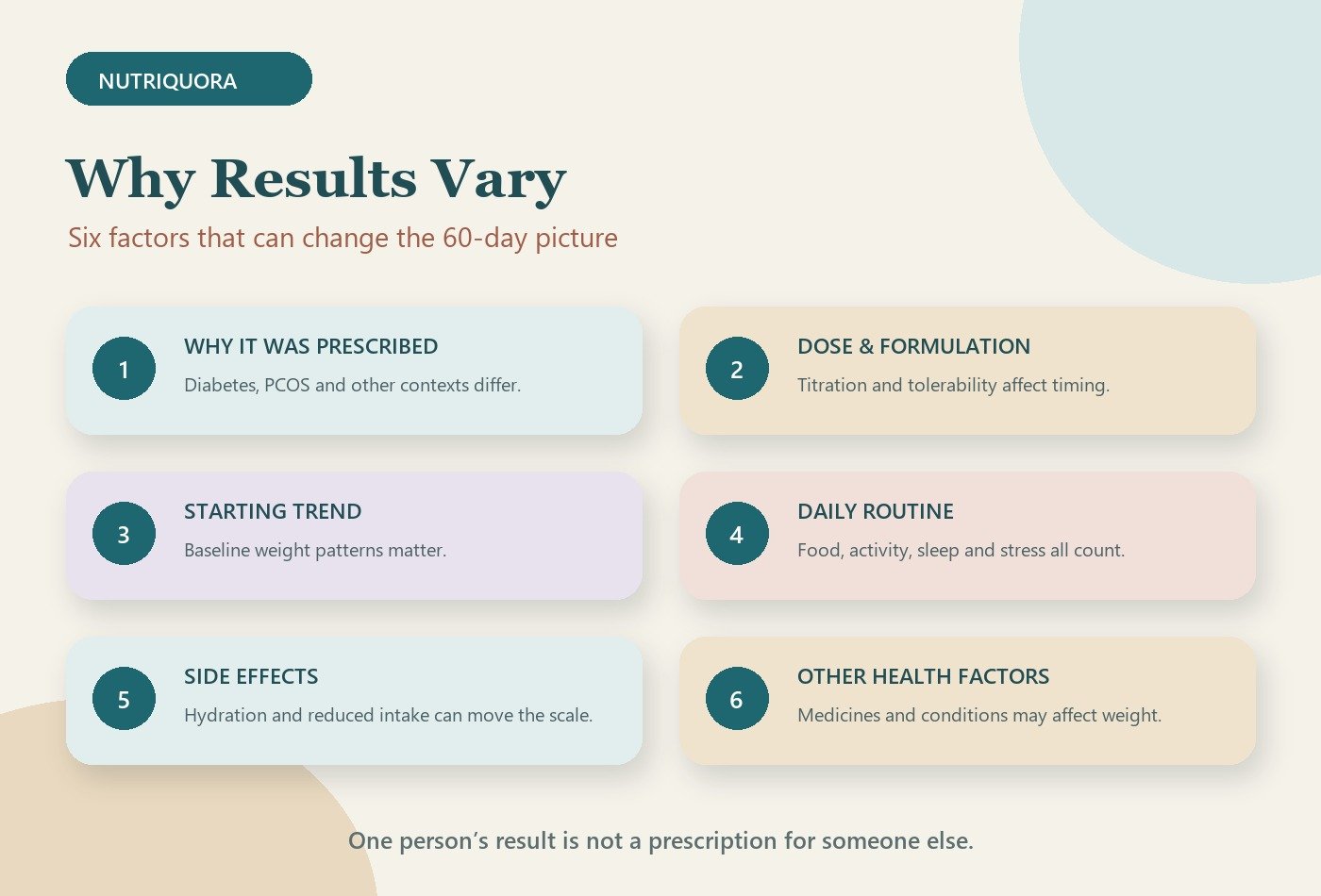
Why results vary so much
The variation in 2-month metformin weight loss results reflects differences in treatment purpose, dose, baseline and daily circumstances.
1. The reason metformin was prescribed
Metformin may be used for type 2 diabetes, gestational diabetes and PCOS.[1][2] Those are different clinical situations. A person’s starting glucose levels, insulin resistance, reproductive goals and other medicines may change how treatment is evaluated.
If metformin was prescribed in a PCOS care plan, NutriQuora’s PCOS breakfast ideas offer flexible meal-building examples; they do not replace advice from your clinician.
2. Dose and formulation
Immediate-release and extended-release products can have different schedules and tolerability. A gradual dose increase is common. Someone who has only recently reached a prescribed dose should not compare their 2-month metformin weight loss results with a person who has taken a stable dose for longer.
3. Starting weight and previous weight trend
A person who was already losing weight before starting metformin may continue that trend. Someone whose weight was stable may see little change. Without a baseline, attributing the result to one medicine is difficult.
4. Eating pattern and physical activity
Metformin does not cancel the energy content of food. At the same time, weight management is more complex than blaming a person for “not trying hard enough.” Food access, sleep, stress, mobility, mental health, hormones and other medical conditions matter.
For broader routine ideas, see our evidence-aware diet and fitness tips and adapt them to your abilities and medical guidance.
5. Side effects and hydration
Early scale changes can reflect reduced food intake or dehydration from vomiting or diarrhea. That is not the same as a safe, sustainable change in body fat. Contact a clinician if gastrointestinal symptoms are persistent or severe.
6. Other medicines and health conditions
Steroids, insulin, some psychiatric medicines and other treatments can affect appetite, glucose and weight. Kidney, liver, thyroid, gastrointestinal and reproductive conditions may also change the clinical picture.
How to track 2-month metformin weight loss results responsibly
Tracking 2-month metformin weight loss results works best when weight is only one part of the log.
Use a simple weekly log rather than weighing repeatedly throughout the day:
| What to record | A practical method |
|---|---|
| Weight trend | Weigh under similar conditions one to three times weekly and compare averages |
| Dose | Record the prescribed dose and whether you took it |
| Side effects | Note nausea, diarrhea, pain, appetite changes or missed meals |
| Glucose data | Record only if your clinician has asked you to monitor it |
| Food and activity | Use brief notes, not punishment or perfectionism |
| Questions | Keep a list for your pharmacist or prescriber |
A two-month review should focus on the whole treatment response—not only the scale.
What if you have no weight loss after two months?
If your 2-month metformin weight loss results show no meaningful change, treat that as information for a review—not a reason to self-adjust the medicine.
No change on the scale does not automatically mean metformin has failed. Ask:
- What condition is metformin treating?
- Have I reached the prescribed dose, or am I still titrating?
- Am I taking it consistently and according to instructions?
- Are side effects affecting food intake or hydration?
- Which clinical measures matter besides weight?
- Could another medicine or condition be influencing my weight?
Bring these questions to a clinician rather than copying a dose or combination from social media.
Metformin with Zepbound for weight loss: what to know
Do not compare combination-treatment outcomes with metformin-only 2-month metformin weight loss results as though they were equivalent.
The phrase metformin with Zepbound for weight loss often appears in searches, but it can create the wrong expectation that two medicines form a standard “stack.” Zepbound is a brand of tirzepatide, a prescription medicine used for weight management in certain eligible people. Tirzepatide can reduce appetite and slow stomach emptying.[5]
Some people may be prescribed both medicines because they have more than one treatment goal. That does not mean the combination is appropriate for everyone, and it does not produce a guaranteed two-month result.
If a clinician prescribes metformin with Zepbound for weight loss, ask which medicine is treating which condition, how side effects will be monitored and what to do if you cannot eat or drink normally. Both medicines can cause gastrointestinal symptoms, so persistent vomiting, diarrhea or dehydration needs medical attention.
Tirzepatide and metformin together for weight loss
Searches for tirzepatide and metformin together for weight loss refer to the same active medicine as the Zepbound section above. Tirzepatide is also marketed under other brand names for different indications.
Do not combine tirzepatide and metformin together for weight loss without a prescriber. The expected result depends on the tirzepatide indication and dose, metformin’s purpose, eligibility, tolerability and the person’s broader health plan. It is misleading to publish a universal eight-week target for the combination.
Safety: when to contact a clinician
The safety of treatment cannot be judged from 2-month metformin weight loss results alone.
Speak with a pharmacist or clinician if common side effects are bothersome, do not improve, or make it hard to eat and drink normally.[2]
Seek urgent medical advice for severe or persistent vomiting or diarrhea, dehydration, or symptoms your medicine leaflet identifies as serious. Metformin can rarely contribute to lactic acidosis, a medical emergency. NHS warning symptoms include vomiting, stomach pain, muscle cramps, breathing problems and severe tiredness.[2]
MedlinePlus also warns that kidney disease and certain acute health situations can increase risk.[1] Follow instructions about illness, scans involving contrast dye, surgery and alcohol.
Frequently asked questions
These questions address the most common misunderstandings about 2-month metformin weight loss results and combination treatment.
Are 4 to 6 pounds normal 2-month metformin weight loss results?
That amount may occur for an individual, but it is not a universal evidence-based target. Clinical studies commonly report averages over longer periods, and individual responses vary.[3][4]
Can metformin cause weight loss without dieting?
Some people lose modest weight while taking metformin, but outcomes vary. “Without dieting” is also imprecise: appetite, food intake, activity, illness and other factors may change after treatment begins.
Why am I losing weight quickly on metformin?
Rapid loss can reflect reduced intake, vomiting, diarrhea or dehydration rather than a desirable treatment response. Contact a clinician if weight loss is unexpected, fast or accompanied by weakness, persistent gastrointestinal symptoms or difficulty staying hydrated.
Why am I gaining weight on metformin?
Metformin does not guarantee weight loss. A clinician can review weight measurements, other medicines, fluid retention, glucose control, thyroid symptoms, sleep and other possible contributors.
Should I stop metformin if I have not lost weight after two months?
No—not without medical advice. Metformin may be helping the condition it was prescribed for even if your weight is unchanged. Stopping it can affect blood glucose or other treatment goals.[2]
Is metformin with Zepbound for weight loss better than metformin alone?
They are different medicines with different approved uses, effects and risks. The question is not which combination is “better” in general, but which treatment is appropriate for a specific person after clinical assessment.[1][5]
Is tirzepatide and metformin together for weight loss safe?
A prescriber may use both in selected patients, but safety depends on health history, kidney function, other medicines, food and fluid intake, side effects and monitoring. Do not start, stop or combine prescription medicines based on an online comparison.
The bottom line
The most accurate answer about 2-month metformin weight loss results is a range of possibilities—not a guaranteed number. Eight weeks can show tolerability and an early trend, but the stronger evidence on average weight change comes from longer follow-up.
Keep the original reason for treatment at the center of the conversation. Track trends, take metformin exactly as directed, report persistent side effects and review results with the clinician who knows your medical history.
How this article was created
NutriQuora used research-assisted drafting to reorganize the original article around the reader’s real questions. The final content was edited for clarity and checked against MedlinePlus, NHS, NIDDK and peer-reviewed Diabetes Prevention Program evidence.This article has not been medically reviewed.
Sources
[1] MedlinePlus. Metformin.
[2] NHS. Metformin.
[3] Diabetes Care. Long-term Weight Loss with Metformin or Lifestyle Intervention in the Diabetes Prevention Program Outcomes Study.
[4] NIDDK. Diabetes Prevention Program (DPP).
[5] MedlinePlus. Tirzepatide Injection.